 My Account

 Login


RAMP stands for Responsible Alcohol Management Program, the Pennsylvania Liquor Control Board’s (PLCB) program for responsible alcohol service. Most people searching “RAMP certification” are really asking about server/seller training. Pennsylvania law requires that training for alcohol service staff, and you finish it with a passing exam score. Strictly speaking, the licensed establishment is what gets certified. This guide explains the difference, who needs what, and the steps for servers, managers and owners.
TL;DR
- RAMP is Pennsylvania’s program for responsible alcohol service. Staff receive training, and the licensee (the bar, restaurant or store) receives certification.
- Alcohol service personnel must complete RAMP server/seller training within six months of being hired, unless they already completed it before the hire.
- You pass the server/seller course exam with a score of 80% or better. The PLCB sets no application fee for certification, but training providers set their own course prices.
- Certification and the training behind it last two years, then must be renewed.
- Certification is voluntary for most licensees, but it becomes mandatory in a few situations, such as an adjudicated violation or a ready-to-drink cocktail permit.
Table of Contents
- What RAMP certification actually means
- Who must take RAMP server/seller training
- How to complete server/seller training
- How a licensee gets RAMP certified
- When RAMP becomes mandatory for a licensee
- What RAMP costs and what a licensee gets back
- Our perspective
- Working in more than one state?
- FAQ
- Sources
What RAMP certification actually means
The PLCB describes RAMP as a voluntary certification built on four prerequisites: owner/manager training, server/seller training, new employee orientation and signage. When a licensee completes all four, it can apply to the PLCB for RAMP certification.
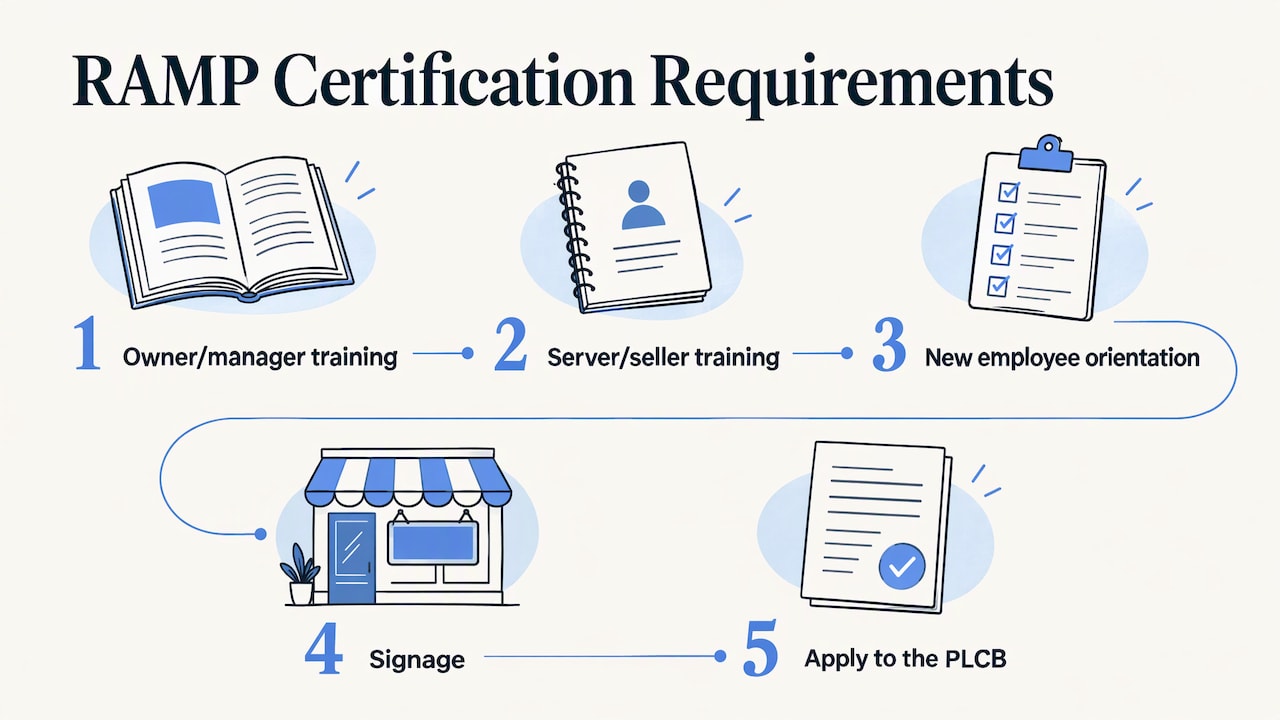
The wording matters, and the PLCB made it explicit when it finalized its rules. According to the Pennsylvania Bulletin, certification is available to licensees only. Servers, sellers, owners and managers receive training, not certification. Online training providers and classroom instructors are authorized or deauthorized, not certified.
So when someone says “I got my RAMP certification” after taking an online course, they mean they completed RAMP server/seller training. That is the document an employer asks for. The PLCB also says that completing server/seller training does not by itself certify the establishment or the person: the establishment is certified only when all four prerequisites are met and the PLCB grants certification.
The four prerequisites at a glance
| Prerequisite | Who it involves | What it takes |
|---|---|---|
| Owner/manager training | At least one owner or the PLCB-approved manager | First enrollment in a classroom setting, later renewals in a classroom, virtual instructor-led or online format |
| Server/seller training | Alcohol service personnel | At least 50% of staff trained at the time of application, each scoring 80% or better on the exam |
| New employee orientation | All alcohol service personnel | Orientation checklist reviewed with staff; new hires oriented within 30 days |
| Signage | The licensed premises | Responsible-service signage prominently displayed |
The details come from the PLCB’s Apply for RAMP Certification page and 40 Pa. Code § 5.205.
Who must take RAMP server/seller training
The training requirement is stricter than the certification requirement. Under Act 39 of 2016, all alcohol service personnel must complete RAMP server/seller training within six months of being hired by a licensee. The exception is someone who completed it before being hired.
In practice, that covers people whose main job is serving, selling or furnishing alcohol, or checking IDs. Think bartenders, waitstaff who pour drinks, bouncers who check IDs and cashiers who ring up alcohol.
A few related rules:
- Internal transfers. An employee moved into an alcohol service role on or after August 8, 2016 must be trained within six months of taking on the new duties, per the PLCB’s RAMP Training page.
- Cashiers at special-permit locations. All cashiers selling wine under a wine expanded permit, or ready-to-drink cocktails under a ready-to-drink cocktail permit, must be server/seller trained. The same page states this.
- Managers. Managers of restaurants, eating place retail dispensers, hotels, clubs, limited distilleries and distributors must complete owner/manager training within 180 days of the PLCB approving their appointment, according to the Pennsylvania Bulletin. The training is waived if they completed it within the two years before the appointment.
How to complete server/seller training
- Choose an approved delivery format. Per the PLCB, server/seller training is available online through approved providers, in scheduled classroom sessions after you register for PLCB+, or with approved instructors. Check the PLCB’s list before you pay, since only authorized providers count.
- Work through the course. The curriculum is standardized. The PLCB’s Bureau of Alcohol Education developed a standard curriculum for instructors, as the Commonwealth explained in a 2010 rulemaking, so the content does not depend on which provider you pick.
- Pass the exam. You need 80% or better to receive credit for the course.
- Give your employer the record. The licensee keeps proof that staff are trained. That record counts toward the 50% staffing threshold if the licensee later applies for certification.
- Renew in two years. Server/seller training expires after two years, and alcohol service personnel must renew it every two years, per 40 Pa. Code § 5.206 and the Bulletin.
Course prices are set by the provider, not the state. The PLCB states that costs for server/seller training are established by training providers and may vary, so compare approved options.
How a licensee gets RAMP certified
If you own or manage an establishment, certification is a separate project from getting staff trained. The sequence:
- Owner/manager training. At least one owner or the PLCB-approved manager must complete it. Since October 1, 2021, the first time an individual enrolls, they must attend in a classroom. Renewals can be in a classroom, virtual (instructor-led) or online. The content covers proper alcohol service, building an alcohol service policy, house rules to prevent sales to minors or visibly intoxicated persons, ID checks, signs of intoxication, and techniques to confirm staff follow the rules, per § 5.205.
- Train at least half your service staff. At least 50% of alcohol service personnel must have passed server/seller training when you apply. You must keep that percentage up, or certification may be rescinded.
- Orient everyone. For a first application, the owner, manager or a designated employee reviews an orientation checklist with all alcohol service personnel. New hires get orientation within 30 days. Keep completed checklists through the person’s employment and for two years after they leave.
- Post the signage. Responsible-service signs must be prominently displayed.
- Apply in PLCB+. There is no fee for applying for certification or recertification. If the PLCB finds the prerequisites satisfied, it approves the application.
The PLCB then issues a notice of certification with the expiration date. Certification lasts two years, and you must keep meeting the requirements throughout that period or it may be rescinded.
When RAMP becomes mandatory for a licensee
For most licensees, certification is voluntary. The PLCB lists four situations where it is required:
- an Administrative Law Judge finds the licensee guilty of sales to minors or visibly intoxicated persons;
- the licensee agrees to it in a conditional licensing agreement;
- before obtaining a wine expanded permit;
- before obtaining a ready-to-drink cocktail permit.
If a licensee was required to certify through a citation or conditional licensing agreement and does not, the PLCB refers the matter to the Pennsylvania State Police, Bureau of Liquor Control Enforcement.
The ready-to-drink cocktail permit is the costly one. According to the PLCB’s legal FAQ, the permit costs $2,500, with an annual renewal fee of 2% of the cost of ready-to-drink cocktails purchased for off-premises consumption. RAMP certification is an eligibility requirement for it.
Expanding off-premises sales often means other approvals too. If your plans include new stockroom racking, a high-piled storage permit in Pennsylvania is a separate fire-code process from RAMP, so plan for both timelines.
What RAMP costs and what a licensee gets back
The PLCB charges nothing to apply for RAMP certification or recertification. The real costs are course fees for server/seller training, the owner/manager classroom session, and the staff hours spent on training and orientation.
The PLCB lists these benefits of certification for licensees:
- knowledgeable, well-trained service staff and management;
- recognition as a responsible licensee in the community;
- less likelihood of dram shop liability;
- a possible liquor liability insurance discount;
- a possible reduction in fines and penalties from an Administrative Law Judge for serving a minor or visibly intoxicated patron.
That last benefit has conditions. The licensee must have been RAMP-certified at the time of the violation and have no citations for either violation in the previous four years, per the PLCB. Also, under § 5.206©, PLCB certification creates a rebuttable presumption that the licensee is RAMP compliant in proceedings before the Office of Administrative Law Judge or the PLCB.
For scale, in a 2010 filing the PLCB reported that 2,300 licensees were then certified out of roughly 15,000 licenses authorizing on-premises sales and service. Many establishments had trained staff without certifying.
Our perspective
We train servers and bartenders every day, and the pattern is consistent: people who understand why a rule exists make better decisions at the bar than people who memorized it for a test.
Pennsylvania’s structure reflects that. Training builds individual skill, orientation builds house habits, signage reminds guests and staff, and certification recognizes that a venue did all of it. A manager who treats the four prerequisites as one system, rather than four chores, ends up with a team that checks IDs the same way every shift.
Our approach to server training is built on the same idea: self-paced online courses you can finish from any device, so a new hire can complete required training around a work schedule instead of cutting into it. Over 100,000 learners have trained with us, and our state-specific courses are designed to cover what each state’s rules ask of servers.
For employers, we think the best compliance plan is simple: know which state rules apply to each location, train everyone who pours or sells, keep the records, and renew on schedule.
the author
Working in more than one state?
RAMP is Pennsylvania-specific. If you also serve in another state, or manage a team across state lines, each state has its own rules on who needs training and how it is delivered. Our state requirements guide walks through the differences.
We offer state-specific alcohol server training courses from $9.99, self-paced and available on any device, plus group and corporate options for managing team compliance in one place. Browse the full course list to find your state.
If your team also handles food, we offer a Food Handler’s Permit at $13.99.
FAQ
Is RAMP certification the same as RAMP server/seller training?
No. Staff complete server/seller training, and the licensed establishment receives certification once all four prerequisites are met and the PLCB approves it. In everyday speech, people call the training “RAMP certification”, but the certificate an employee holds shows training.
How long does RAMP last?
RAMP certification is valid for two years, and the PLCB’s notice states the expiration date. Owner/manager and server/seller training also expire after two years and must be renewed every two years.
Do I need RAMP training if I only work a few shifts?
If your primary responsibility is serving, selling or furnishing alcohol, or checking IDs, state law requires the training within six months of being hired. Ask your manager whether your role falls under alcohol service personnel. If you completed the training before being hired, you do not need to repeat it for the new job as long as it is still current.
Does it cost anything to apply for RAMP certification?
The PLCB charges no fee for certification or recertification. Server/seller training is priced by the approved provider, so your cost depends on the course you choose.
Sources
- RAMP | Pennsylvania Liquor Control Board
- RAMP Training | Pennsylvania Liquor Control Board
- Apply for RAMP Certification | Commonwealth of Pennsylvania
- 40 Pa. Code § 5.205, RAMP certification prerequisites
- 40 Pa. Code § 5.206, RAMP certification
- Pennsylvania Bulletin, 51 Pa.B. 1378 (2021)
- Pennsylvania Bulletin, 40 Pa.B. 2838 (2010)
- PLCB Legal FAQ: ready-to-drink cocktail permit
- How Do You Get a High-Piled Storage Permit in Pennsylvania?