 My Account

 Login


Good restaurant staff training has three parts: a written plan that runs longer than a couple of days, hands-on practice on the floor, and the certifications your state requires, finished early so no one serves a guest without them. The certification part is the easiest to get done quickly. Our self-paced online courses for alcohol server certification and food handler permits can be completed from any device, so new hires can finish them before or during their first week.
This guide is for owners and managers who hire servers, bartenders, hosts and kitchen staff, and for servers and bartenders who need to get certified to start work. It gives you a day-by-day plan, how long each role takes to become independent, the topics to cover, a checklist you can copy, and the certification rules that matter most.
TL;DR
- Plan on at least 5 to 7 days of structured training for new hires, not 2 to 3, and keep checking in after the first two weeks.
- Write the plan down: orientation and food safety on day one, menu and POS next, then shadowing, reverse shadowing and a sign-off shift.
- Time to a first independent shift depends on the role, from 2 to 4 shifts for a host or busser to about 2 weeks for a server with no experience.
- Get required certifications done early. In California, on-premises alcohol servers and managers must be certified within 60 days of their first day of work.
- Online courses handle the rule-based material, so your trainers can spend their time on the menu, the floor and your standards.
Table of Contents
- Why a longer, written training plan pays off
- A 10-day server training plan you can copy
- How long training takes by role
- What restaurant staff training should cover
- A restaurant employee training checklist
- One-on-one, group or online: which format fits
- Certifications to finish early
- Where our courses fit
- Our perspective
- FAQ
- Sources
Why a longer, written training plan pays off
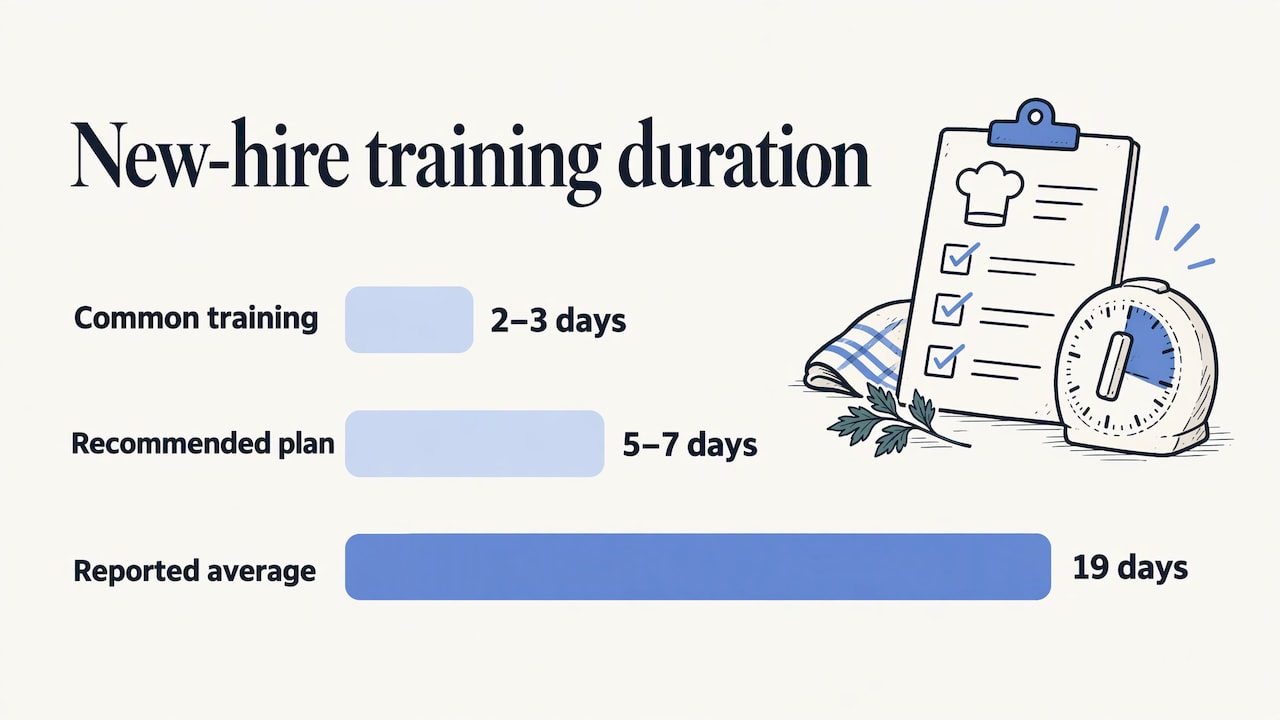
Most restaurants train new people for a few days and hope the rest is picked up on the job. New York City’s Department of Small Business Services, in its Restaurant Playbook on training, advises extending new-hire training from the common 2 to 3 days to at least 5 to 7 days. It also lists three common failures: training that lasts only 2 to 3 days, learning by doing with nothing else, and knowledge that passes from employee to employee without being written down.
The playbook ties training quality to guest experience, food quality, food cost and employee satisfaction. That matches what most managers see: a server who does not know the allergen list, or a cook who was never shown the station standard, costs you comps, waste and, eventually, the employee.
The same playbook gives a simple frame for any plan:
- Prepare. Have schedules and manuals ready before the first day.
- Check in. Do it daily at first, then weekly, then monthly.
- Follow through. Keep checking in after the first couple of weeks, because training does not end there.
One published figure gives a sense of the norm: Yelp’s restaurant training guide reports an average of 19 days to train new restaurant staff. Your own number will vary by role and by how much of the material is ready to hand over on day one.
A 10-day server training plan you can copy
The following structure comes from a two-week server training plan and works well as a template. Adjust the days for your menu size and your service style.
| Day | Focus | What the trainee does |
|---|---|---|
| 1 | Orientation and food safety | Tour, handwashing, allergen procedures |
| 2 | Menu and steps of service | Learn the menu, practice on the POS (point-of-sale system) |
| 3 to 4 | Shadow shifts | Follow an experienced server and observe |
| 5 | Menu and allergen test | Pass the test before taking any tables |
| 6 to 7 | Reverse shadow | Serve a section of 2 to 3 tables while the trainer watches |
| 8 to 9 | Full section | Run a full section with the trainer nearby |
| 10 | Sign-off shift | Work a shift observed against a written server checklist |
Three details make this plan work.
The test comes before the tables. Day 5 is a gate. A new server who cannot answer allergen questions should not be the person guests ask them of.
Reverse shadowing flips the roles. In days 3 and 4 the trainee watches. In days 6 and 7 the trainee does the work and the trainer watches, which is where the corrections happen.
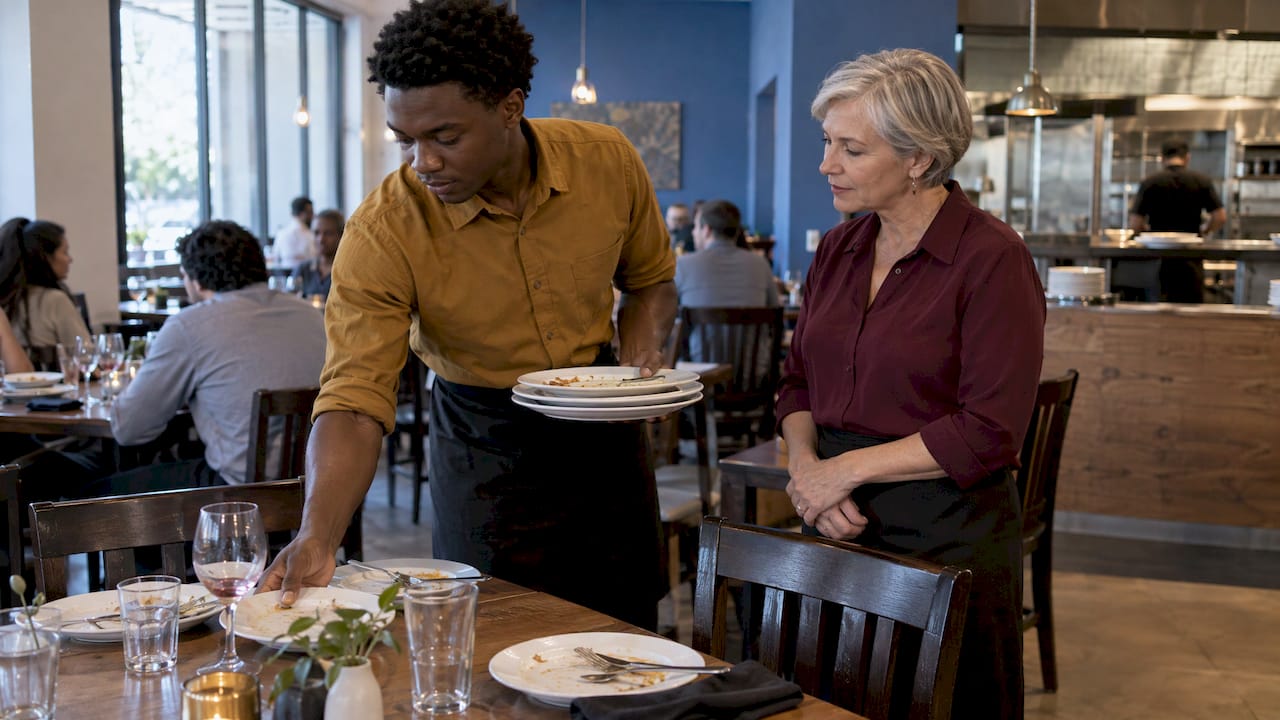
Sign-off is written. A checklist on day 10 turns “seems ready” into something you can point to, and it gives the next hire the same standard.
How long training takes by role
Not every job needs ten days. The same plan gives typical ranges for when a new hire is ready for an independent shift:
| Role | Typical time to independent work |
|---|---|
| Host or busser | 2 to 4 shifts |
| Experienced server, new to your restaurant | 4 to 6 shifts |
| Server with no experience | About 2 weeks |
| Bartender | 1 to 2 weeks for specs and pour standards |
| Line cook | 1 to 2 weeks on one station, weeks to months for the whole line |
| Dishwasher or prep cook | 2 to 5 shifts |
These are working ranges from one published plan, not rules. Treat them as a starting point and let the sign-off checklist, not the calendar, decide when someone is ready.
If you need a way to help new people bond with the existing crew in those first weeks, some managers use team activities for new hires to speed up integration alongside the formal training.
What restaurant staff training should cover
Build your topics in layers. Everyone gets the first three, and each role adds its own.
Food safety
Every employee who handles food, drinks, tableware or the line should learn handwashing, illness reporting, temperature control, cross-contact and allergen procedures before handling food for guests. Many states and counties require a food handler card or permit; check your local health department for the rule where you operate. Managers often need a higher-level food manager certification, which may involve a proctored exam, meaning one supervised by an approved examiner.
Workplace safety
California’s Division of Occupational Safety and Health says in its Restaurant Employees Workplace Safety & Health Guide that effective safety training fulfills an element of the Injury and Illness Prevention Program required by California Code of Regulations title 8, section 3203. It recommends covering the specific hazards in your restaurant, the hazards that cause injuries, how to control them, and your workplace policies and safe work practices. It also recommends frequent refresher training, especially for new and younger employees.
The guide frames this as a business case as well as compliance: lower turnover, less lost time, lower workers’ compensation costs and higher productivity.
Washington State’s labor department, working with the state restaurant association, gives supervisors a useful sequence in its hospitality workplace safety manual. Each employee gets a documented orientation before starting work. Each is trained and competent before operating equipment or doing a hazardous task, and each is issued the required protective equipment. After that come periodic safety checks and observed performance reviews with documented evaluations. The manual recommends short, verbal, demonstration-based training where the employee performs the task and mistakes are corrected on the spot.
Responsible alcohol service
Anyone who pours or serves alcohol needs to know how to check IDs, recognize signs of intoxication, refuse service and handle difficult moments. Many states require a state-recognized course and a certificate. The rules differ by state, so check yours before the first shift.
Harassment and violence prevention
Sexual harassment prevention and workplace violence prevention training protects staff and guests. Requirements vary by state; California, for example, has its own rules for both.
Menu, service and technology
Yelp’s guide lists the front-of-house topics managers most often cover: cross-training, POS and management-system training, upselling, problem solving and conflict resolution, table management and timing, menu expertise with allergen awareness, and guest-interaction role-play. For the back of house, add station setup, recipes and specs, prep and labeling, and cleaning schedules.
A restaurant employee training checklist
Copy this into your own document and sign off each line with a date and a trainer’s initials.
Before day one
- Schedule for the first two weeks written and shared
- Employee handbook and role manual ready
- Uniform, apron, name tag and any required protective equipment ready
- Trainer assigned and told what to cover
- Required online courses assigned, with a due date
Day one
- Tour of the restaurant, exits, first aid and where to report an injury
- Handwashing, illness reporting and hygiene rules
- Allergen procedures
- Pay, schedule, tip policy and behavior expectations
- Anti-harassment and violence prevention policies
Week one
- Menu knowledge, including ingredients and allergens
- Steps of service and POS practice
- Shadow shifts with a named trainer
- Written menu and allergen test passed
- Safety training for the equipment and tasks of the role, with each task demonstrated and then performed by the employee
Week two
- Reverse shadow, then a full section or station
- Alcohol service certificate completed, where required and for the role
- Food handler card completed, where required
- Observed sign-off shift against the written checklist
- Check-in conversation: what is confusing, what is going well
Ongoing
- Weekly check-ins in the first month, monthly after that
- Refresher training on safety and allergens
- Cross-training on a second position
- Updated checklist whenever the menu or procedures change
One-on-one, group or online: which format fits
OpenTable’s restaurant training guide describes three formats: one-on-one pairing with a manager or senior team member, group training for chains hiring several people at once, and online training. It notes that only 19% of restaurants offered online training to new team members when it was written in 2023, while Gen Z and Millennials preferred it, usually alongside hands-on instruction.
That points to a simple split:
- Online training for anything that follows a rulebook and must be documented: food handler basics, alcohol laws, harassment prevention. It is consistent, it can be done in any order of shifts, and each person gets a completion record.
- One-on-one training for the things only your restaurant has: the menu, your service style, your station standards.
- Group sessions for orientation and policy walk-throughs when several people start together.
This split keeps your best servers and cooks teaching what makes your restaurant yours, not reading the same legal rules aloud to every new hire.
Certifications to finish early
What you must complete depends on your state and sometimes your county. California is a clear example for alcohol service. The state’s Alcoholic Beverage Control department explains on its RBS Training Program page that, effective July 1, 2022, AB 1221 and AB 82 require on-premises alcohol servers and managers to register in the ABC RBS Portal, complete training from an authorized Responsible Beverage Service provider, and pass the ABC Alcohol Server Certification exam within 30 days of confirmed training. Servers and managers must be certified within 60 days of their first date of employment. Courses are offered in five languages and the exam in eight.
The lesson for any state: find the deadline, put it on the onboarding checklist, and have the course assigned before the first shift. For California, our Responsible Beverage Service training guide and certification requirements guide walk through the process step by step.
A practical order for a new hire’s first week:
- Food handler card, if your county requires it, before touching food.
- Alcohol server course, started in week one and finished well inside your state’s deadline.
- Harassment and violence prevention training, completed in the first weeks.
- Food manager certification for anyone moving into a supervisory role.
Where our courses fit
We built our platform for exactly this stage of onboarding. Courses are self-paced and work on any device, so a new server can finish one on a phone between shifts. Here is what we list on our site, with prices as published:
| Course | Price |
|---|---|
| California Responsible Beverage Server Training Course | $19.99 |
| Food Handler’s Permit | $13.99 |
| Alabama Server Training Course | $3.99 |
| Arkansas Server Training Course | $11.99 |
| Arizona Liquor Training, Basic On Sale or Off Sale | $30.00 each |
| Arizona Liquor Training, Management On & Off Sale | $50.00 |
| California Workplace Violence Prevention | $34.99 |
| State-Specific Alcohol Server Training | From $9.99 |
We also offer food manager certification with an online or in-person proctored exam, sexual harassment training and workplace violence prevention training on our courses page. Prices for those are not published, so check the page for current details.
For a team, our group and corporate training makes it easier to manage who has completed what. More than 100,000 learners have trained with us.
Our state pages are the best place to start: Texas, Michigan and Tennessee bundle server training with food handler courses, and Wyoming has its own course.
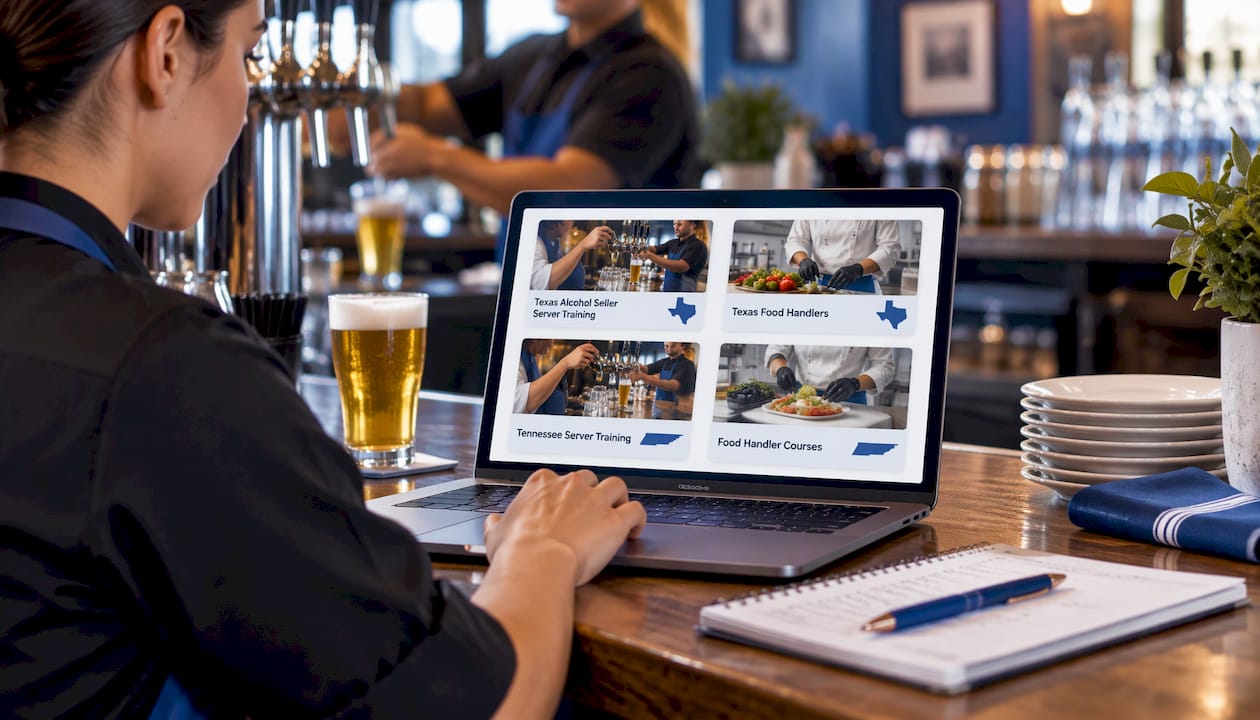
If you are hiring now, pick your state on our course shop or set up group training for your team, and add the course links to your first-week checklist.
Our perspective
We hear the same thing from owners and servers: nobody minds training, they mind training that eats a week of shifts or that nobody can prove was done. That is why we built our courses to be finished at your own pace, on whatever device you have in your hand.
Our view is that restaurant training works best when it is split in two. The rules that every employee must know, such as alcohol laws, food handling and workplace safety, belong in a short course with a clear completion record. The skills that are unique to your restaurant belong with your best people on the floor.
When the rulebook part is handled online, your trainers do not spend day one reading regulations aloud. They teach the menu, the section, the pace of service. For a team, one place to assign and track courses means no one slips through the 30-day or 60-day windows that state rules set.
Servers and bartenders get the same benefit. A state-recognized certificate in hand makes you ready for the first shift and easier to hire.
the author
FAQ
How long should restaurant employee training take?
Plan for at least 5 to 7 days of structured training, according to New York City’s Restaurant Playbook, which calls the common 2 to 3 days too short. Roles differ: a host or busser may be independent in 2 to 4 shifts, while a server with no experience needs about 2 weeks. Keep checking in after the first two weeks.
What is the first thing to teach a new restaurant employee?
Start with orientation and food safety: a tour of the building, handwashing, illness reporting and allergen procedures. After that, move to the menu, the steps of service and the POS, then to shadow shifts. Assign any required online courses on day one so they are done well before deadlines.
Do all restaurant employees need alcohol server certification?
It depends on your state and the role. In California, on-premises alcohol servers and managers must be certified within 60 days of their first date of employment. Other states set their own rules, so check your state’s alcohol authority and assign the course to everyone who serves or manages alcohol.
Can restaurant staff training be done online?
Yes, for rule-based topics such as food handling, alcohol service and harassment prevention. Online courses give every hire the same material and a completion record. Pair them with hands-on instruction for your menu, your stations and your service standards.
How do I know a new hire is ready to work alone?
Use a written sign-off checklist and an observed shift, as in the day 10 step above. The trainee should pass the menu and allergen test, run a full section or station with the trainer nearby, and complete the certifications your state requires.
Sources
- Restaurant Playbook: Training, NYC Department of Small Business Services
- How to Train Restaurant Staff: 2-Week Plan and Checklist
- How to develop a successful restaurant training program, Yelp
- Restaurant Training in Today’s World, OpenTable
- Restaurant Employees Workplace Safety & Health Guide, California DIR-DOSH
- Hospitality Workplace Safety Training, Washington State L&I
- RBS Training Program, California Alcoholic Beverage Control