
 My Account

 Login


A certified food protection manager (CFPM) is a person in a food business who has passed an accredited food manager exam and can show they know how to prevent foodborne illness. Most health departments expect at least one on staff at any restaurant or bar that serves unpackaged food. The exam must come from a program accredited by the ANSI National Accreditation Board (ANAB). If you want to get certified, you can take our Food Manager’s Certification online, at your own pace, on any device, and then sit the proctored exam online or in person.
TL;DR
- A CFPM is the person who has passed an ANAB-accredited food protection manager exam. A food handler card is a different, more basic credential.
- The FDA Food Code asks for a certified person in charge, but each state, county or city decides who must hold the certificate and when.
- Many jurisdictions give a new or changed-ownership business about 60 days to have a certified person on staff.
- Certificates are commonly valid for five years and are renewed by testing again. Check your local health department for the exact term.
- Choose a program that is ANAB-accredited and accepted locally, and confirm the exam is proctored, because the proctor is what makes the result count.
Table of Contents
- What a certified food protection manager is
- CFPM vs. food handler: which one do you need?
- Who needs food safety certification?
- Food safety certification requirements: what varies by place
- How to become a certified food protection manager
- Can you take the food manager exam online?
- Why certified managers matter beyond compliance
- Our view: certification is a skill, not just paperwork
- Get certified with ABC Server Training
- FAQ
- Sources
What a certified food protection manager is
The title comes from the FDA Food Code, the model set of rules most states use to write their own restaurant regulations. Under section 2-102.12 of the Food Code, the person in charge is expected to be a certified food protection manager who has shown proficiency by passing a test that is part of an accredited program. States adopt the code in different versions, so the exact wording varies by place.
The Florida Department of Health describes it in plain terms: a CFPM has passed a written exam approved by ANAB, and the certificate is valid for five years from the date it is issued, then renewed by testing again.
The role is more than a certificate on the wall. The Minnesota Department of Health lists CFPM duties that include identifying hazards in daily operations, developing policies to prevent foodborne illness, and making sure a person in charge is present whenever food is being prepared. It also describes the CFPM as a leader of the food safety team who shares knowledge with employees.
What ANAB accreditation means
The Conference for Food Protection sets the standards that exam programs must meet, and ANAB is the body that accredits programs against them. The Conference explains this on its manager certification page. In practice, accreditation is the thing health inspectors look for. A certificate from a non-accredited course may not be accepted, however much you studied.
CFPM vs. food handler: which one do you need?
These are two separate credentials, and mixing them up is the most common mistake new hires and owners make.
| Food handler card | Certified food protection manager | |
|---|---|---|
| Who it is for | Line cooks, prep cooks, servers, bartenders, hosts and other staff who handle food | The owner, manager, chef or other person in charge |
| Depth | Basic safe-handling practices | Advanced topics such as HACCP, microbiology, time and temperature control, and person-in-charge knowledge |
| How many you need | Usually every food worker, where a card is required | Often one certified person per establishment |
| Typical term | Set by the state or county | Commonly five years |
The Tacoma-Pierce County Health Department in Washington draws this line clearly. All food workers in the state need a food worker card, while a CFPM certificate covers advanced topics and an establishment only needs one CFPM. San Francisco’s city site puts it in restaurant terms: most people who prepare, store or serve food, including bartenders, servers and hosts, need a food handler card, and at least one person at a restaurant must also be a food safety manager.
If you are a server or bartender, your first step is usually the handler card. Our Food Handler’s Permit course covers it online. If you are moving into a supervisor role, or you own the place, the manager certificate is the one that counts. Our guide on the difference between a food handler and a food manager goes into more detail.
Who needs food safety certification?
The short answer is any business that prepares or serves unpackaged food, and that includes bars and restaurants. The details depend on where you operate, but the pattern is consistent across the examples below.
- California. Fresno County says facilities handling unpackaged food, including restaurants, bars, cafeterias, bakeries, most markets, commissaries and mobile food units, must have an owner, manager or employee pass an approved, accredited exam. The state rule is CalCode Section 113716.
- Alaska. The Alaska Department of Environmental Conservation says establishments that serve or prepare unwrapped food must employ at least one full-time CFPM involved in daily operations. Limited-service facilities, such as convenience stores selling only prepackaged food, are not required to have one.
- Illinois. The state’s health department says food establishments must be supervised by a CFPM under the state Food Code, certification requires an ANSI-accredited course and exam, and Chicago runs its own separate program.
- Nevada. In Washoe County, all food establishments except Risk Level 1 and temporary ones must have at least one CFPM.
- Minnesota. New establishments must have a CFPM on staff within 60 days of opening.
If a bar only pours drinks and sells sealed snacks, the rule may not apply to you. Whether it does is decided by your local health department, so look up your county or city environmental health page before you assume you are exempt.
The 60-day window
Many California counties allow a grace period. Fresno County gives a facility 60 days after opening, changing ownership, or losing its certified person to get someone certified. That is a start-up deadline, not a reason to wait. The exam takes preparation, and a manager who quits the week before an inspection can leave you uncovered.
Food safety certification requirements: what varies by place
There is no single national license. The FDA publishes the model code, and states, counties and cities decide what they adopt. Four things differ most.
Who must be certified. Some places want the owner or any employee. Some want a person who is on duty during operations. Santa Clara County, California says the certified person does not need to be present at all times, while other jurisdictions are stricter about a certified person in charge being on site.
One person, one location. El Dorado County says a certificate cannot be used at multiple facilities, and Santa Clara County says the same, with an exception for multiple facilities at one location under the same ownership. An owner with two restaurants usually needs two certified people.
How long it lasts. Five years is the common figure, as in Illinois, Florida and California counties. A few states set a shorter term, so read your own state’s page.
Local programs. Chicago has its own certification. Washoe County, Nevada stopped approving instructors in 2015 and now lets the permit holder document a training plan or use an accredited CFP-recognized program. Always confirm which program your local authority accepts before you pay for a course.
Our food manager training requirements guide and the overview of food handler requirements across states can help you narrow down your state.
How to become a certified food protection manager
The process has the same five steps everywhere. Here is what each one takes and where people go wrong.
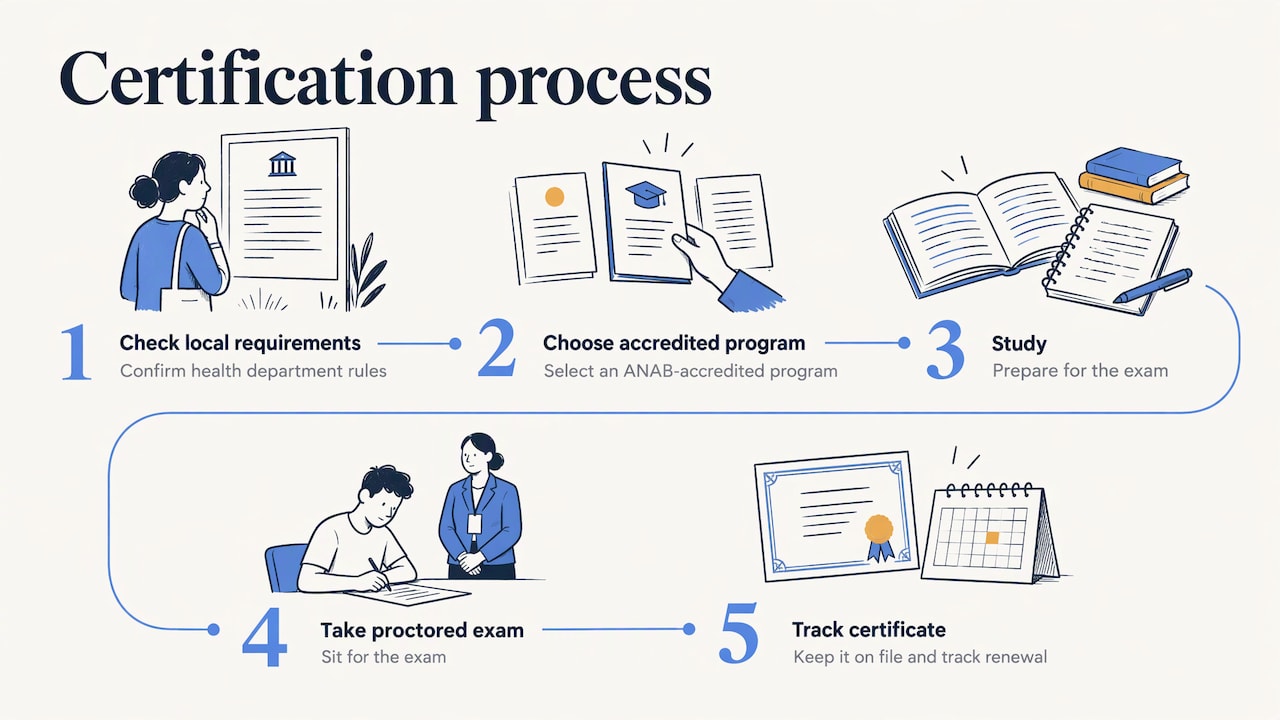
1. Confirm what your health department requires
Find your county or city environmental health page. Look for who must be certified, the deadline for a new business, the accepted exam programs, and whether the exam must be proctored in person. The common mistake is relying on a neighboring state’s rules or on an old blog post. If you work in Florida, our Florida food handling requirements page is a good local example.
2. Choose an ANAB-accredited program
Accreditation is what lets inspectors accept the result. Our Food Manager’s Certification is offered with an online proctored exam or an in-person proctored exam, so you can pick the format that suits your schedule and what your local authority accepts. A Spanish-language in-person option is also available.

3. Study the content
The course covers the principles behind the Food Code: safe storage, preparation and service, and how to run a food safety system. Exam questions lean on numbers you need to know cold, such as holding temperatures. For example, 135°F is the minimum for hot holding in foodservice. Our training is self-paced and works on any device, so you can study on a phone between shifts. People fail by cramming the night before, so spread your study over a few sessions.
4. Sit the proctored exam
The exam is supervised by a proctor, either in a room with you or online through a remote session. This is the step that cannot be skipped. Have your ID ready, set up a quiet space if you test online, and read the instructions before you start. Pass marks and question counts depend on the exam provider, so check the details when you register.
5. Keep the certificate on file and track the renewal
El Dorado County, for one, says the certificate must be kept on file at the facility. Put the expiry date in your calendar. Renewal means passing the exam again, and a lapsed certificate leaves you out of compliance.
Can you take the food manager exam online?
In many places, yes. A remote-proctored exam is supervised by a person watching through your webcam, and the result counts the same as an in-person one where your health department accepts it. Not every jurisdiction does. Some require a particular format, so check before booking. We offer both an online proctored exam and an in-person proctored exam, which means you do not have to change providers if your local rule changes.
Why certified managers matter beyond compliance
The Alaska Department of Environmental Conservation explains the public-health reasoning: establishments with certified managers have better food safety practices, fewer critical violations on inspection reports and are less likely to have an outbreak. The Tacoma-Pierce County Health Department adds that the training covers benefits such as better sanitation and a stronger grasp of regulations, which can help the business’s profits.
For an owner, that translates into cleaner inspections and fewer surprises. For a bartender or server hoping to move up, a manager certificate is a credential that shows you can run a shift safely.
Our view: certification is a skill, not just paperwork
Most people who come to us want one thing: to be legal by the time the inspector walks in. We understand that. But we built our courses so the certificate also means something on a busy Friday night.
We deliver training online, at your own pace, on any device, because food service people do not work nine to five. A cook can finish a module on a break, and a manager can resume it at home. That flexibility is why more than 100,000 learners have trained with us.
For owners, the harder problem is keeping a whole team covered. Our group and corporate options are made so that one person can manage training for several employees without chasing paper. Pairing handler cards for staff with a manager certificate for the person in charge is the simplest way we know to stay in compliance and reduce liability.
Pick a program your health department accepts, take the exam seriously, and write the renewal date down.
the author
Get certified with ABC Server Training
If you are ready to certify, our Food Manager’s Certification comes with an online proctored exam or an in-person proctored exam, and the course runs self-paced on any device. Your team can start with our Food Handler’s Permit, which is $13.99. Owners who need to train several people can look into our group and corporate training.

We also offer state-specific alcohol server training, which many bartenders need alongside a food credential, as well as workplace safety courses for the whole team.
FAQ
What is a certified food protection manager?
A CFPM is a food service professional who has passed an exam from an ANAB-accredited food protection manager program. The FDA Food Code expects the person in charge to hold this credential, and many states and counties require at least one certified person per establishment. It is more advanced than a food handler card.
Is a food handler card the same as a food manager certificate?
No. A handler card covers basic safe food handling and is usually required for most employees. A manager certificate covers deeper topics such as HACCP and running a food safety system, and is held by the person in charge. Many businesses need both, for different people.
How long is a food manager certificate valid?
Five years is the most common term, and Illinois, Florida and several California counties all use it. Renewal is done by passing the exam again. Check your own state’s health department for the exact period, since a few places set a shorter one.
Do I need a certified manager if I own a small bar?
It depends on what you serve and where you are. Establishments that serve or prepare unpackaged food are generally covered, while places selling only prepackaged items are often exempt. Your county or city health department makes the final call, so confirm with them before you open.
How soon must a new business have a certified manager?
Many jurisdictions allow about 60 days after opening or a change of ownership. Fresno County in California and the Minnesota Department of Health both use that window. Treat it as a deadline for being compliant, not a target to hit at the last minute.
Sources
- FDA Food Code 2022, section 2-102.12
- Conference for Food Protection, Manager Certification
- Florida Department of Health, Food Manager Certification
- Minnesota Department of Health, CFPM fact sheet
- Tacoma-Pierce County Health Department, CFPM FAQs
- SF.gov, Get a food handler card
- County of Fresno, Food Safety Certifications and Classes
- Alaska DEC, Certified Food Protection Manager
- Illinois Department of Public Health, CFPM
- Northern Nevada Public Health, CFPM FAQ
- Santa Clara County, Food safety certification
- El Dorado County, Food Safety Certification
- Superior Kitchen Equipment, Hot holding temperatures