 My Account

 Login


There is no single national age for bartending. Each state sets its own minimum, and it usually falls between 18 and 21, with a few outliers on either side. The age can also change with what you do (carry drinks or pour them), what you pour (beer or spirits) and where you work. The safest way to start is to find your state’s rule, then get the server training it expects. We built our state-specific alcohol server courses for exactly that step.
TL;DR
- Most states let 18-year-olds serve alcohol, but about 20 states limit bartending (mixing and pouring) to people 21 and older.
- A few states go lower: Maine allows 17 and West Virginia 16 in the 2022 state table. Others go higher for certain drinks, such as Ohio for wine and spirits.
- “Serving” and “bartending” are often treated as different jobs, and a 18-to-20-year-old can usually only do the first, often under supervision.
- Child-labor law still applies to anyone under 18, and a city or an employer can be stricter than the state.
- Many states expect server training. Check your state’s rule, then complete an approved course before your first shift.
Table of Contents
- The short answer: 18 to 21, depending on where you work
- Serving versus bartending: why the job title matters
- Minimum bartending age by state
- Can you bartend at 14, 15, 16 or 17?
- Two other layers: child-labor law and local rules
- Age is only half of it: server training
- How to get started, step by step
- Perspective
- Get certified for your state
- FAQ
- Sources
The short answer: 18 to 21, depending on where you work
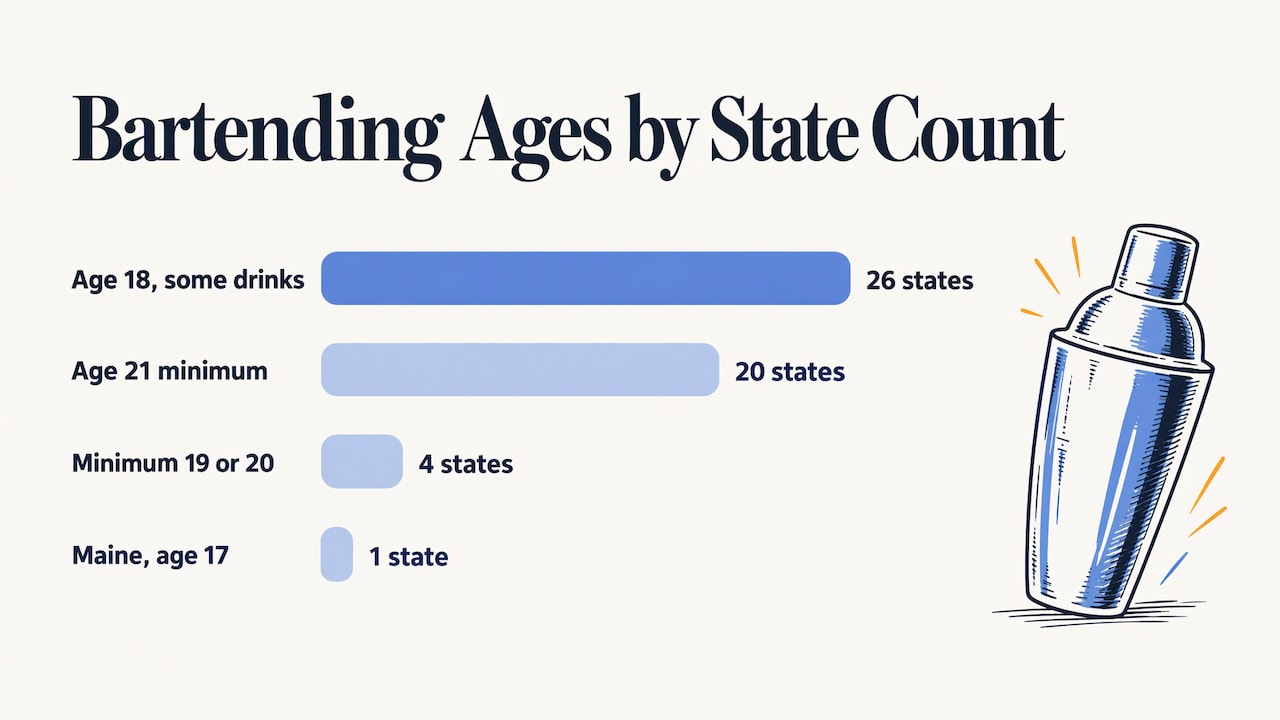
Two official sources give the clearest national picture. A federal report to Congress from SAMHSA, the federal substance-abuse agency, states that as of January 1, 2021, 20 states limited bartending to people 21 and older, while 26 states allowed 18-year-olds to bartend for at least some beverage types. Maine allowed 17-year-olds, and four states set the minimum at 19 or 20.
For servers the picture is looser. The same report says three states required servers to be 21, one allowed 17-year-old servers, eight required 19 or 20, and the rest allowed 18-year-old servers.
So the practical rule of thumb is this: if you are 21, you can bartend almost anywhere in the country. If you are 18 to 20, you can probably serve alcohol in most states, but whether you can stand behind the bar depends on where you live.
Serving versus bartending: why the job title matters
Laws and employers use two different words. A server (or waitperson) brings drinks to guests. A bartender mixes, pours or dispenses them. The National Institute on Alcohol Abuse and Alcoholism’s policy database uses these same two terms, and notes that in many states the lowest permitted ages come from exceptions to a higher general minimum.
Three states show how finely the line can be drawn:
- Kansas. The state’s alcohol agency sets 18 to serve and 21 to mix or pour in drinking establishments and clubs, with no minimum age for bussing, kitchen or janitorial work.
- Virginia. Its administrative code bars anyone under 18 from selling, serving or dispensing alcohol for on-premises consumption, and anyone under 21 from preparing or mixing drinks as a bartender. An 18-year-old may still sell or serve beer at a counter.
- Indiana. You must be 21 to bartend. A person 18 but under 21 who completes an approved server training program may serve in a restaurant or hotel dining area with appropriate supervision.
If a job posting says “bartender” but the state says 21 for that duty, an 18-year-old applicant is looking at a barback or server role first. That is a normal path, and many bartenders start exactly there.
Minimum bartending age by state
The table below comes from a state-by-state policy chart compiled as of January 1, 2022. It lists the states with the most notable bartending minimums. Laws change, so treat it as a starting point and confirm with your state’s alcohol agency.
| Minimum age to bartend | States |
|---|---|
| 21 | Alabama, Alaska, Arkansas, California, Delaware, Kansas, Mississippi, Missouri, Nevada, Utah |
| 20 | Kentucky |
| 19 | Idaho, Nebraska |
| 19 for beer, 21 for wine and spirits | Ohio |
| 17 | Maine |
| 16 | West Virginia |
Source: state alcohol policy chart, policies as of January 1, 2022. States not listed there generally set the bartending minimum at 18, or 21 for certain duties or drink types.
The same chart lists server minimums of 18 in most states, 19 in Alabama, Arkansas, Idaho, Indiana, Nebraska and Ohio, 20 in Kentucky, 21 in Alaska, Nevada and Utah, 17 in Maine and 16 in West Virginia. It also shows that nine jurisdictions require a manager or supervisor to be present when an underage employee serves or bartends.
Drink-type exceptions
Some states split the age by what is in the glass. A 2026 state ranking reports that Maryland and North Carolina require 21 to bartend spirits but 18 for beer and wine, and that Ohio requires 21 for wine and spirits. If you are working in North Carolina, our North Carolina server training course covers the state’s expectations for servers.
Recent changes
Rules do move. Delaware’s 2026 session law, approved June 10, 2026, says a person may not be involved in the sale, service or preparation of alcoholic liquor unless 18 or older. It lets 18-, 19- and 20-year-olds sell and serve, but not prepare drinks unless a person 21 or older is working directly behind the bar with them. It also bars anyone under 19 who is still in secondary school from preparing alcohol. Virginia’s code was amended effective February 12, 2025. If your state’s rule is older than a couple of years, check the agency’s current page before you rely on it.
Can you bartend at 14, 15, 16 or 17?
For 14- and 15-year-olds the answer is almost always no. Alabama’s labor department states that 14- and 15-year-olds may not work in on-premises alcohol establishments, except immediate family members who do not serve, sell, dispense or handle alcohol. The same document says minors 16 and older may work as busboys, janitors, dishwashers, cooks, hostesses or seaters. That pattern, kitchen and floor jobs but no alcohol, is typical.
For 16- and 17-year-olds it depends on the state:
- Iowa. Employees must be at least 18 to sell and dispense alcohol for on-premises consumption, but 16- and 17-year-olds can sell and serve alcoholic beverages in a restaurant if certain requirements are met.
- Michigan. An on-premises licensee may permit a 17-year-old to sell or serve if the person completed a server training program and the licensee has the supervisory personnel required during the shift.
- Minnesota. Minors under 18 may not serve, dispense or handle intoxicating liquor consumed on premises, though 16-year-olds may bus, wash dishes or host in a restaurant.
- Maine and West Virginia. These are the lowest minimums in the 2022 state chart, at 17 and 16 respectively.
The pattern for teenagers is supervision plus training. Where a state lets someone under 18 serve, it usually requires a supervisor on the shift and completion of an approved server program.
Why the caution? SAMHSA explains that age limits exist because younger employees, particularly unsupervised ones, may lack the maturity and experience to verify age and resist peer pressure to complete illegal sales. Training is how that gap gets closed.
Two other layers: child-labor law and local rules
The alcohol-control minimum is not the only age that matters. The NIAAA database notes that where a state sets no minimum for servers or bartenders, child-labor and employment laws may still set a floor. For a minor, that can mean limits on hours as well. In Florida, for example, a restaurant labor guide states that 14- and 15-year-olds may work only 7 a.m. to 7 p.m., and no more than 15 hours per week on school days.
Two more layers can raise the bar:
- City or county rules. Local governments can generally set a higher age than the state, never a lower one. If you live in a big city, ask the local licensing office whether it adds to the state rule.
- Employer policy. A business can choose to hire only people 21 and older even when state law allows 18. Insurance and liability concerns are the usual reason, so a posting that says 21+ is not necessarily a legal requirement.
Age is only half of it: server training
Meeting the age minimum gets you in the door. In many states you also need a responsible-beverage-server certificate, or your employer needs you to have one. Training covers checking IDs, spotting intoxication, refusing service and the liability that comes with a mistake.
In some states the training is what makes a younger hire possible. Michigan’s 17-year-old exception and Indiana’s 18-to-20 exception both rest on completing an approved program. You can see how the requirements compare in our guide to state requirements for alcohol beverage service training and our overview of which states require alcohol server training.
A few state examples:
- California. The state’s server training requirement is covered in our guide to alcohol server certification in California.
- Washington. See our overview of Washington’s alcohol server training requirements.
- Oregon. Our page on Oregon alcohol server education requirements lays out what the state expects.
- Mississippi, Montana and South Dakota. Each has its own course page: Mississippi, Montana and South Dakota.
How to get started, step by step
- Find your state’s minimum for your duty. Search for your state alcohol agency’s page on employee age. Look for the words “serve” and “dispense” separately.
- Check your city and the employer. Ask the venue whether it requires 21 or more than the state does.
- Confirm the training requirement. Find out whether your state, county or employer requires a server certificate, and which providers it approves.
- Complete the course before your first shift. Our courses are online, self-paced and work on any device, so you can finish around a school or work schedule.
- Keep your proof. Save the certificate and give a copy to your manager. Note the renewal period shown on it.
- If you are under 21, start in a role the law allows. Server, host, barback or busser jobs build the experience that bartending positions ask for.
Perspective
Age questions are usually the first thing new hospitality workers ask us, and the honest answer is that the number matters less than being ready on your first shift. A 21-year-old who has never practiced checking an ID is more exposed than an 18-year-old server who has completed approved training.
That is why we focus on making state-specific training easy to finish: online, at your own pace, on any device. For businesses, the same approach scales to a whole team, with group and corporate options that make compliance simpler to manage. More than 100,000 learners have trained with us, and we design our programs to help you meet your state’s requirements and reduce liability.
If you are 18 to 20 and wondering how to get behind a bar, our advice is to get certified first. It shows a manager you take the responsibility seriously, and in several states it is exactly what the rules ask for.
the author
Get certified for your state
Our state-specific alcohol server courses start from $9.99 one-off. Published examples include the Alabama Server Training Course at $3.99, the Arkansas Server Training Course at $11.99 and the California Alcohol Beverage Control Responsible Beverage Server Training Course at $19.99. Arizona Liquor Training Basic On Sale is $30.00, and the Management On & Off Sale course is $50.00. You can browse every course on our shop page.
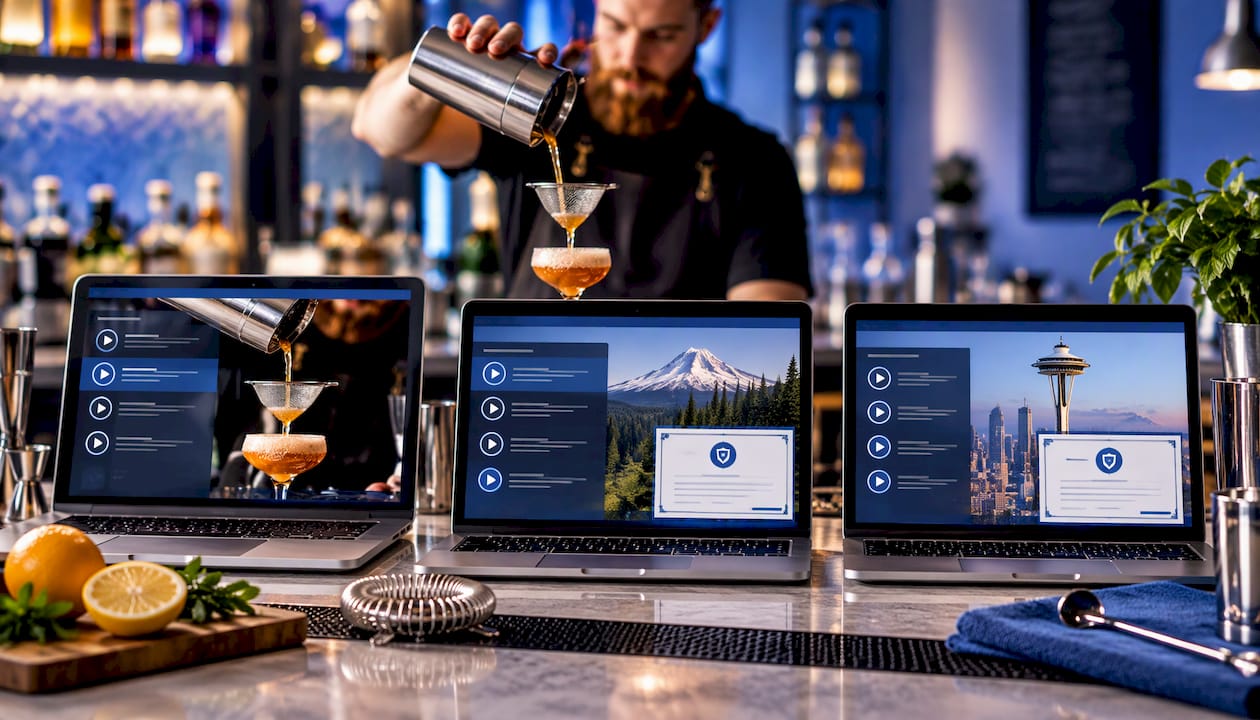
If you manage a bar or restaurant, our group and corporate training lets you handle the whole team in one place. We also offer food handler and workplace safety courses, so new hires can finish everything they need together.
FAQ
Can you be a bartender at 18?
In many states, yes, at least for some drinks. SAMHSA reported that 26 states allowed 18-year-olds to bartend for at least some beverage types as of January 1, 2021. Other states, including California and Kansas, require 21 to mix or pour. Check your own state’s rule and your employer’s policy.
Can you be a bartender at 14?
No. Child-labor and alcohol laws generally keep 14- and 15-year-olds out of jobs that serve, sell, dispense or handle alcohol on premises. Alabama’s labor department is one example, with a narrow exception for immediate family members who do not handle alcohol. Younger teens can look at jobs the law allows, such as dishwashing or hosting in some states, once they reach the permitted age.
Do I need training to bartend?
Many states require or strongly expect responsible-beverage-server training, and some tie younger employees’ eligibility to it. Even where it is optional, employers often ask for it. Find your state on our server training pages to see what applies.
Can a city set a higher age than the state?
Yes. Local governments can generally raise the minimum but not lower it, so a city may require 21 even where the state allows 18. Ask your local licensing office or the venue before you apply.
Sources
- SAMHSA 2022 Report to Congress: Minimum Ages for On-Premises Servers and Bartenders
- NIAAA Alcohol Policy Information System: About this policy
- NIAAA Alcohol Policy Information System: Minimum ages for servers and bartenders
- Kansas Department of Revenue Alcoholic Beverage Control employee FAQs
- Virginia Administrative Code 3VAC5-50-50
- Indiana ATC FAQ on dispensing alcohol
- State alcohol policy chart, policies as of January 1, 2022
- Bartending Age by State 2026, World Population Review
- Delaware 2026 session law, Volume 85, Chapter 284
- Alabama Department of Workforce child labor pamphlet
- Iowa Department of Revenue business operations
- Michigan Compiled Laws section 436.1707
- Minnesota child labor overview
- Florida restaurant labor laws handbook