 My Account

 Login


Employee harassment training is a course that teaches every person on your payroll what counts as harassment, how to report it and what happens next. No federal law requires private employers to provide it, but several states do, and a documented program is one of the strongest things you can show if a complaint ever lands. The simplest way to cover a whole team is self-paced online training that each person finishes on any device and that leaves you with a completion record. Our sexual harassment training is built for exactly that, for individuals and for groups.
This guide is for servers, bartenders, managers, restaurant and bar owners and any employer who needs to decide who to train, when, and on what.
TL;DR
- No federal law requires private employers to provide harassment training, but states such as California and New York do, and the rules often depend on where the employee works.
- Good training names prohibited conduct, gives workplace-specific examples, explains how to report, and promises protection from retaliation.
- Supervisors need more than staff: how to respond to a complaint, and what happens if they fail to report.
- California requires training within six months of hire and every two years. New York requires it every year.
- Online, self-paced courses work when they are interactive and produce a certificate you can file.
Table of Contents
- Is harassment training required by law?
- What harassment training should teach
- Training for managers and supervisors
- New hires and refresher timing
- Harassment training in restaurants and bars
- What to look for in online, self-paced training
- Rolling training out to a whole team
- Training your team with ABC Server Training
- Our perspective
- FAQ
- Sources
Is harassment training required by law?
There is no federal training mandate. The EEOC (the U.S. Equal Employment Opportunity Commission, the federal agency that enforces workplace anti-discrimination law) expects employers to run a harassment prevention program, and its employer checklist lists regular compliance training for all employees and for managers and supervisors as one part of it. That is guidance, not a statute. The requirement itself comes from states and a few cities.
Two examples show how different the rules are:
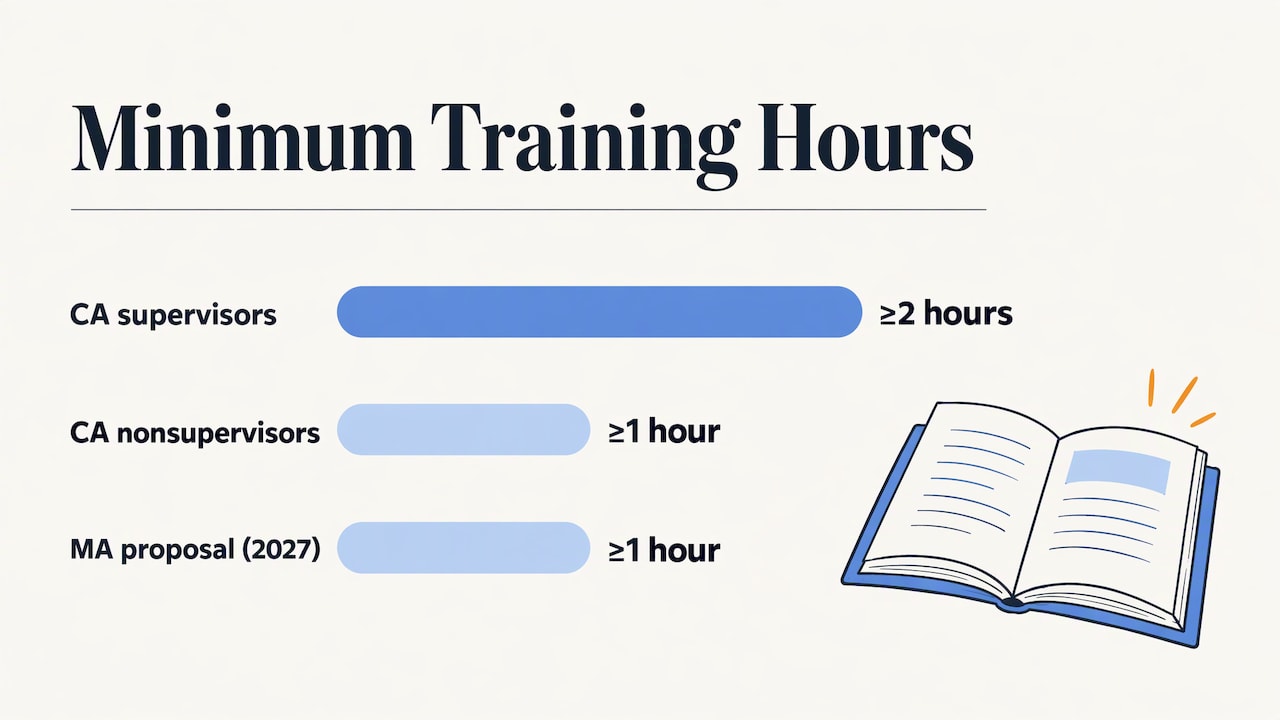
- California. Under the amended text of AB-1803, employers with five or more employees must give supervisors at least two hours of interactive sexual harassment training and nonsupervisors at least one hour, every two years.
- New York. State law requires every employer to give all employees interactive sexual harassment training at least once a year. The state sets no minimum number of hours.
Other states, including Connecticut, Delaware, Illinois and Maine, also have their own mandates with different employer-size thresholds and deadlines. Our state-by-state overview and guide to requirements by state walk through them. Some rules attach to where the employee physically works, not where your company is based, so an owner with locations in two states may owe two different programs.
Rules also keep moving. A Massachusetts bill, H.5023, would require employers with more than 25 employees to provide at least one hour of interactive harassment-prevention training each year, starting January 1, 2027. It is a proposal, so check the legislature’s page for its status before you plan around it. California’s AB-1803 also adds anti-hate speech training starting January 1, 2028.
Why train even where no law says you must
The EEOC explains that an employer is automatically liable when a supervisor’s harassment results in a firing, a failed promotion or lost wages. When a supervisor creates a hostile work environment without such an action, the employer can avoid liability only by proving it reasonably tried to prevent and promptly correct the behavior and that the employee unreasonably failed to use the options provided. Training, a written policy and a working reporting channel are how an employer builds that proof.
What harassment training should teach
Start with the definition your employees will be tested against. The EEOC describes harassment as unwelcome conduct based on race, color, religion, sex (including sexual orientation, transgender status and pregnancy), national origin, age 40 or older, disability or genetic information. Federal coverage generally starts at 15 employees for Title VII and the ADA and 20 for age claims. A charge with the EEOC generally has to be filed within 180 days, a window state law can extend.
The EEOC’s Promising Practices guidance is the best checklist for course content. Effective training for all employees includes:
- A description of prohibited harassment and conduct that might rise to it.
- Examples tailored to your workplace.
- Employees’ rights and responsibilities if they experience or see something.
- Encouragement to report, and an explanation of the complaint process.
- Assurance that retaliation is prohibited.
- The range of consequences for prohibited conduct.
- A chance to ask questions.
- Contact information for the people who handle complaints.
The same guidance says training works best when senior leaders back it, when it is repeated regularly, when it reaches every level and location, when it is offered in the languages your staff actually use, and when it is reviewed and updated over time.
Examples that make it real
Abstract definitions do not help someone who is unsure whether a coworker crossed a line. Examples drawn from the EEOC’s 2024 guidance include unwanted sexual advances at an off-site event, ableist posts in a work group chat, sexist comments in a video meeting, racist imagery visible on a video call and ageist social media remarks aimed at a coworker. Note how many of these happen outside the building. Good training makes clear that harassment can follow your team into chats, calls and after-hours events.
Training for managers and supervisors
A manager’s duties differ from a line employee’s, so the course should too. The EEOC’s checklist for managers says supervisor training should give realistic methods for dealing with harassment they see or are told about, explain the sanctions for failing to use those methods, and give clear instructions for reporting harassment up the chain of command, including the sanctions for failing to report.
In plain terms, a supervisor who hears a complaint cannot treat it as a private conversation. The company is on notice the moment a supervisor knows, which is why supervisors need a separate module or a longer course. California builds this in by requiring two hours for supervisors against one for everyone else. New York asks employers to make managers aware of the extra requirements of their roles and lets them add separate supervisor training.
If you are searching for manager harassment training, check that it covers three things: what to do the same day a complaint arrives, how to avoid retaliation when handling it, and how to coach a team member whose behavior is slipping toward a problem.
New hires and refresher timing
Timing depends on the state. In California, new nonsupervisory employees must be trained within six months of hire and new supervisors within six months of taking the role. Seasonal or temporary workers hired for fewer than six months must be trained within 30 calendar days or 100 hours worked, whichever comes first (AB-1803). New York sets no fixed deadline for new hires, though the state encourages training as soon as possible.
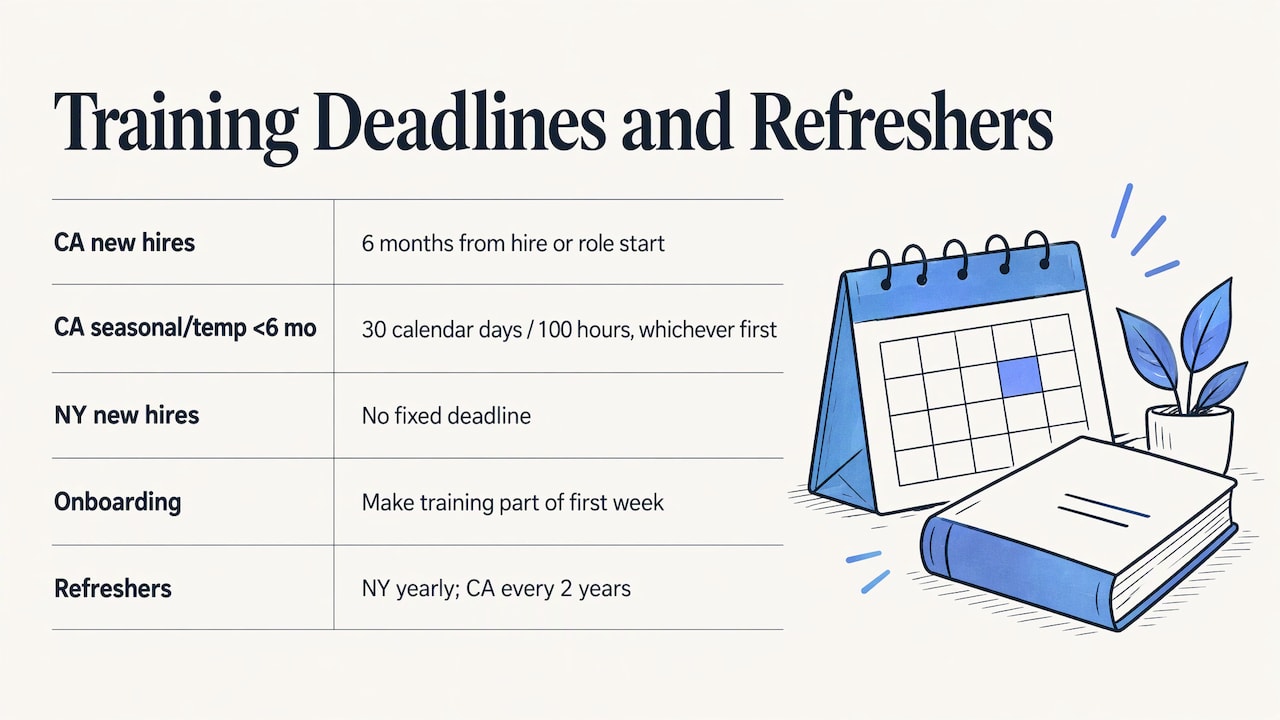
A practical rule for employers in any state: make the course part of onboarding, in the first week. A new hire who learns the policy and the reporting path on day three is protected sooner, and you never have to track a six-month clock for them. Then put refreshers on a calendar tied to your state’s cycle, for example every year in New York and every two years in California.
Harassment training in restaurants and bars
Hospitality has features that general office courses ignore: late shifts, tipped staff who depend on guests, alcohol service, tight kitchens and young or seasonal workers. Harassment can come from a coworker, a manager or a customer, and a server needs to know what to do in each case. The EEOC asks for examples tailored to your workplace, and in a restaurant that means scenarios about guests, shift changes and after-closing drinks.
Seasonal staff matter too. If you hire for summer or the holidays in California, the 30-day or 100-hour rule applies to them. That is a good reason to have a course a new server can complete on a phone before their first busy shift.
We also train this audience on alcohol server certification and food handler permits, so a restaurant can manage compliance courses for its servers, bartenders and kitchen staff in one place.
What to look for in online, self-paced training
Self-paced online courses suit shift workers, because no one has to gather the whole staff in a back room. Interactivity is where they differ, and in states that require it, interactivity is the legal test.
New York’s guidance says online training counts as interactive if it includes section questions that require correct answers, a way to submit questions and get timely answers, or a post-training feedback survey. A video or document with no interaction or feedback does not qualify. California’s statute likewise calls for interactive training.
Use this short list when you evaluate a course:
- Content matches the EEOC list above, including reporting steps and non-retaliation.
- Separate supervisor and employee tracks, or a supervisor option, with the right hours for your state.
- Works on a phone, tablet or computer, so servers can finish between shifts.
- Gives a completion record you can store in the employee file. Massachusetts’ proposed bill would require five-year retention of completion records, and keeping records for several years is a sensible habit everywhere.
- Group management, so one person can assign the course and see who has finished.
Rolling training out to a whole team
A workable plan for a restaurant, bar or small business has five steps:
- List who works where. Count employees by state, because rules follow the work location. Separate supervisors from everyone else.
- Pick the standard. Use the strictest state rule you operate under as your company-wide minimum, so you run one program, not three.
- Assign and set a deadline. Add the course to onboarding and give current staff a fixed window to finish.
- Collect and file the certificates. Keep them with each employee’s records and note the date the next refresher is due.
- Pair training with a policy and a reporting channel. The EEOC lists a regularly communicated policy, a resourced reporting system and prompt, proportionate discipline alongside training. A course alone does not make a program.
Our guide on what employers can do to augment harassment training covers those surrounding pieces. If you operate in California, see our page on whether harassment training is required for your employees there.
Training your team with ABC Server Training
We offer sexual harassment training online, so each employee can complete it at their own pace from any device. For employers, we offer group and corporate options that make team compliance easier to manage. More than 100,000 learners have trained with us, and our programs are designed to be state-recognized and to support compliance and reduce liability.

If your team also needs alcohol server certification, food handler permits or workplace violence prevention, you can handle those through the same platform. See all courses or contact us about group training.
Our perspective
Most owners we talk to think of harassment training as a box to tick before an audit. We see it differently: it is the first conversation your employees have with your company about what is acceptable, and what happens when something goes wrong.
That is why format matters. A course nobody can finish between shifts does not get finished. We built our training to be user-friendly, available on any device and self-paced, so a bartender can complete it on a phone and a manager can see the team is done without chasing anyone.
For employers, the real value is consistency. When every server, cook and supervisor takes the same course, with the same definitions and the same reporting steps, nobody has to guess what the policy means. Pair that with a clear policy and a supervisor who knows what to do the moment a complaint arrives, and you have a program you can stand behind.
For individual workers, training means knowing your rights and knowing where to take a concern. That is worth an hour of your time.
the author
FAQ
What states have mandatory harassment training?
California and New York are the clearest examples: California requires training every two years for employers with five or more employees, and New York requires it annually from every employer. Connecticut, Delaware, Illinois and Maine also have mandates, with different thresholds and deadlines. Check the rules where each of your employees works.
Do part-time and seasonal workers need harassment training?
In California, yes. Seasonal and temporary employees hired for under six months must be trained within 30 calendar days or 100 hours worked, whichever comes first. In New York, the law covers all employees. In any state, training them in the first week is the simplest approach.
Can employees take harassment training online?
Yes, where it is interactive. New York accepts online courses that include questions requiring correct answers, a way to ask questions or a feedback survey. A video or document with no interaction does not qualify. Choose a self-paced course that gives each employee a completion record.
Do managers need different harassment training than other employees?
Yes. Managers and supervisors need to know how to respond to a complaint, what sanctions apply if they fail to act, and how to report up the chain of command. California requires two hours for supervisors and one hour for others.
Sources
- Harassment | U.S. Equal Employment Opportunity Commission
- Promising Practices for Preventing Harassment | EEOC
- Checklists for Employers | EEOC
- Checklists for Employers, manager and supervisor training | EEOC
- Employer Guide for Sexual Harassment Prevention | State of New York
- AB-1803 Employment: sexual harassment, as amended | California Legislature
- Bill H.5023 | Massachusetts Legislature
- What Constitutes Workplace Harassment in 2024? | Nemeth Law PC