
 My Account

 Login


The fastest way to pass a food handler test is to practice on the topics it always covers: handwashing, temperature control, cross-contamination, illness rules, and cleaning and sanitizing. The 15 questions below follow those topics, and each answer explains why it is right. When you are ready for the real exam, our Food Handler’s Permit course is $13.99 and is done online at your own pace, on any device.
These are study questions built on the federal food safety rules, not the wording of any one state’s or employer’s exam. Your state or county sets the exact passing score and the list of approved courses, so check those before you pay for anything.
TL;DR
- Most food handler exams test the same core ideas: hand hygiene, time and temperature, cross-contamination, employee illness, and cleaning and sanitizing.
- Passing scores are set locally. Examples: 70% in California and Riverside County, 15 of 20 correct in Alaska, 75% in Oregon.
- Practice works best when you read why each wrong answer is wrong, not when you memorize a list of numbers.
- Many places require a card within 14 to 30 days of starting a job, so take the course early.
- Food managers face a different, longer exam than food handlers.
Table of Contents
- 15 food handler practice questions with answers
- What a food handler test covers
- Passing scores and rules differ by place
- How to prepare in a week
- Food handler test vs. food manager test
- Get your card
- Our view on practice tests
- FAQ
- Sources
15 food handler practice questions with answers
Cover the answers, pick one option for each, then check yourself. The numbers come from the FDA Food Code, the federal model that most state and local food rules are built on.
Hands and personal hygiene
1. You are assembling sandwiches. Which should you use to touch the bread and sliced turkey: bare hands, or tongs?
Answer: tongs, deli tissue, single-use gloves or dispensing equipment. The Food Code generally prohibits bare-hand contact with exposed ready-to-eat food, because that food gets no further cooking to kill germs.
2. How long should you scrub your hands when washing?
Answer: at least 20 seconds. The CDC describes the steps as wetting, soaping, scrubbing the backs of hands, between fingers and under nails, rinsing and drying. Hand sanitizer is not a substitute for washing.
3. A cook has vomiting and suspects norovirus. When can they return to work?
Answer: only after staying home while sick and for at least 48 hours after symptoms stop, per the CDC’s food worker guidance linked above. The CDC notes that sick food workers can easily contaminate food.
4. You cut your finger at work. What do you do?
Answer: clean and cover the wound with a bandage, and add a glove or finger cot if you handle food. Wounds and jewelry both appear on typical practice tests, as in this university extension practice exam.
5. Can you taste food and smell it to check that it is still safe?
Answer: no. The CDC warns that you cannot see, smell or taste the germs that cause food poisoning. Check storage times and throw food out when the time is up.
Time and temperature
6. What is the maximum temperature for receiving cold TCS food?
Answer: 41°F (5°C) or below, with a few specified exceptions. TCS means time/temperature control for safety: foods such as meat, dairy, cooked rice and cut melons that spoil or grow germs quickly if left warm.
7. What is the minimum cooking temperature for seafood?
Answer: 145°F for 15 seconds, the answer used in the Mississippi State practice test. Always check with a food thermometer, never by color.
8. How should hot food be cooled?
Answer: from 135°F to 70°F within two hours, using methods such as an ice-water bath. Cooling in a deep, tightly covered pot is the classic wrong answer.
9. How long can food sit out before it goes in the refrigerator?
Answer: no more than 2 hours, or 1 hour when the air is above 90°F, according to the CDC’s food safety mistakes list.
10. What is the safe way to thaw frozen chicken?
Answer: in the refrigerator, under cold running water, in the microwave followed by immediate cooking, or as part of the cooking process. Never on the counter.
Cross-contamination, cleaning and allergens
11. You put raw chicken on a plate, grill it, and want to put the cooked chicken back on the same plate. Is that fine?
Answer: no. The CDC lists putting cooked meat on a plate that held raw meat among its dangerous mistakes. Use a clean plate.
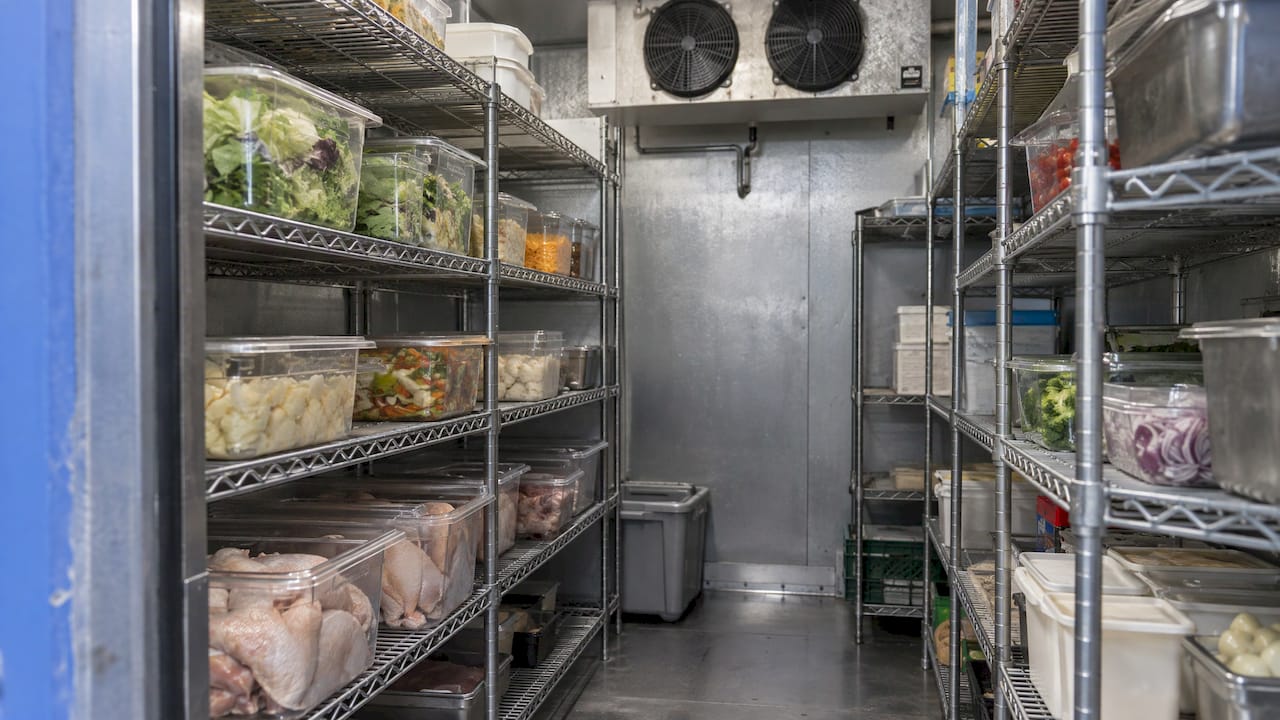
12. In the walk-in cooler, where does raw poultry go relative to ready-to-eat food?
Answer: below it, on the lowest shelf, so juices cannot drip onto food that will not be cooked again.
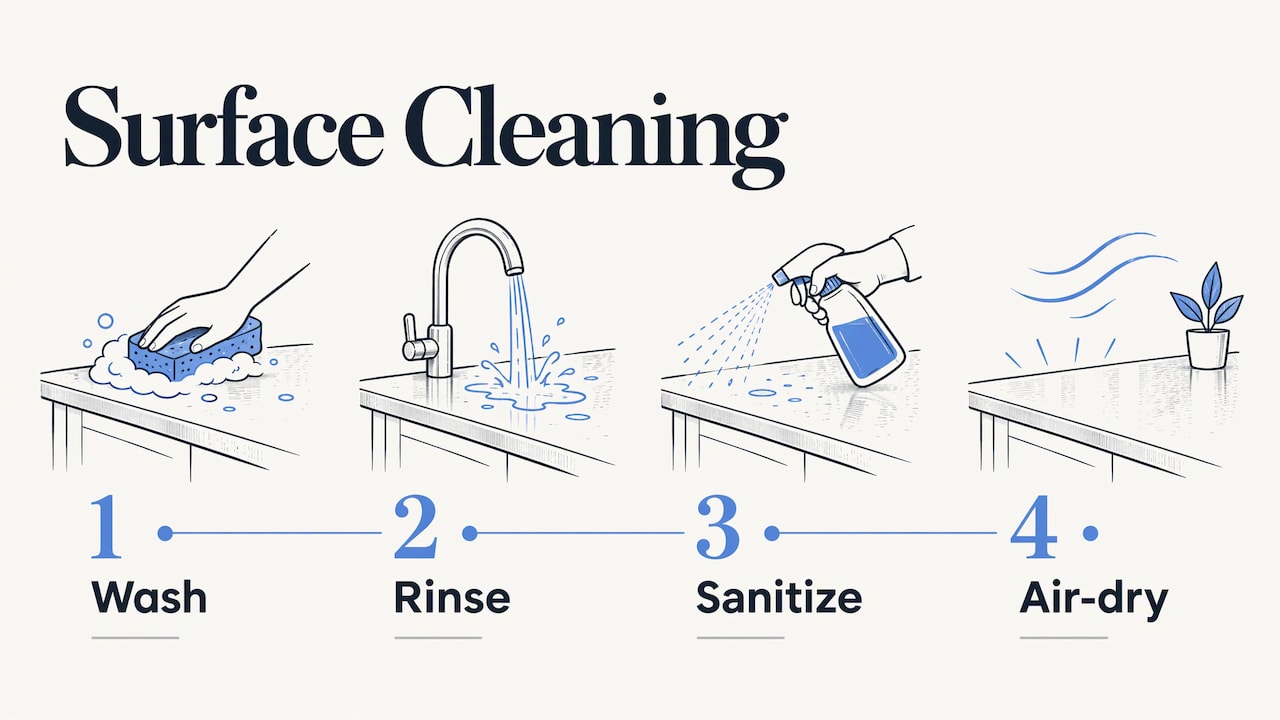
13. What is the correct order for cleaning a food-contact surface?
Answer: wash, rinse, sanitize, then air-dry. Sanitizing a dirty surface does not work, because food residue weakens the sanitizer.
14. Should you wash raw chicken before cooking it?
Answer: no. The CDC lists this as a mistake because washing splashes germs around the sink and counters. Cooking to the right temperature kills them.
15. A guest says they have a peanut allergy. What do you do?
Answer: tell the manager or the person in charge, check ingredients and labels, and prevent contact between the allergen and the guest’s food, including through shared utensils and surfaces.
If you got 12 or more right, you know the core. If not, read the explanation under each miss and write down the rule in your own words.
What a food handler test covers
The exact questions change, but the topic list stays steady. Alaska’s food worker exam, for example, covers approved-source receiving, food protection, time and temperature requirements, worker health and hygiene, handwashing, and washing and sanitizing food-contact surfaces. The Mississippi State practice test adds high-risk populations, hepatitis A, Bacillus cereus in cooked rice, allergens, thawing, and pests.
The CDC groups the biggest causes of illness into five risk factors: poor personal hygiene, improper holding temperatures, improper cooking temperatures, contaminated equipment, and food from unsafe sources. If you build your study around those five, you will recognize most questions.
Question styles to expect
- Number recall: a temperature or a time (41°F, 135°F, 20 seconds, 2 hours).
- Scenario questions: a short workplace situation where you choose the safest action.
- Order and sequence: cleaning steps, handwashing steps, cooling stages.
- Spot the mistake: a description of a cook’s routine with something wrong in it.
For scenarios, choose the answer that stops the risk now and tells the person in charge. The Food Code rests on overlapping safeguards, including controls on employee health and on hands as a route for contamination, so the safest answer is usually the right one.
Cleaning and storage questions are easier when you can picture a real routine. A refrigerator cleaning schedule shows how cold storage, labeling and regular wipe-downs fit into daily work in a kitchen.
Passing scores and rules differ by place
There is no single national food handler test. States, counties and cities set who needs a card, how soon, and what score passes. A sample of what is published:
| Place | Passing rule | Cost or validity |
|---|---|---|
| California (state law) | At least 40 questions, 70% to pass | Card within 30 days of hire, valid 3 years |
| Riverside County, CA | 50 questions, 70% (35 correct) | $28.00 for online training and in-person exam |
| Alaska | 20 questions, 15 correct | $10 test, card valid 3 years |
| Oregon | 75% | Training manual includes a practice test |
| Utah | Certificate within 14 days, permit within 30 days of hire | Permit valid statewide for 3 years |
Local deadlines can be even shorter. San Bernardino County requires a card within 14 calendar days of employment. Guam’s health certificate exam has 25 questions and a 70% passing score, and the certificate must be renewed yearly.
Because the rules are local, start with your county health department’s list of accepted training, then pick a course that fits. Our guide to food handler training requirements across states walks through how to stay compliant, and we have state pages for Utah, Colorado, Missouri, New Jersey, Rhode Island, Arkansas and Florida.
A rule employers should know
In California, since January 1, 2024, SB 476 requires employers to pay for food handler training and testing, pay employees for training time, and not make an existing card a condition of hire. If you manage a team there, group training that you buy once and assign to everyone keeps that cost and the deadlines in one place.
How to prepare in a week
You do not need weeks. Most people who work a short study routine are ready within a few days.
- Day 1: learn the numbers. Write the key figures on one card: 41°F cold holding, 135°F hot holding, 145°F seafood, 20 seconds of handwashing, 2 hours out of temperature control.
- Day 2: hands and illness. Know when to wash (after the restroom, handling raw meat, touching your face, taking out trash) and when a sick worker must stay home.
- Day 3: cross-contamination. Practice shelf order in the cooler and the wash, rinse, sanitize sequence.
- Day 4: take a full practice set. Time yourself and mark every miss.
- Day 5: review the misses. Mississippi State Extension advises reviewing missed questions and understanding why the right answer is right instead of relying on memorization.
- Day 6 or 7: take the real course and exam.
Oregon’s training manual puts study questions throughout and a practice test at the end, which is the same idea: learn a topic, test it right away, then repeat.
Common ways people lose points
- Mixing up cold holding (41°F or below) with the danger-zone range.
- Treating sanitizer as a replacement for handwashing.
- Choosing the answer that sounds fastest, not the one that is safest.
- Forgetting that the person in charge must be told about illness or an allergy.
Food handler test vs. food manager test
A food handler card is for the people who prepare, serve or handle food. A food manager certification is for the person in charge, and it asks more: managing a food safety system, not just following rules. The manager exam is proctored, meaning someone supervises it, either online or in person. Some cities also require a certified supervisor on site whenever the establishment operates, as New York City does.
So a food manager practice test goes beyond the 15 questions above, into HACCP-style planning, staff training, and inspections. If you are the one answering to the health inspector, we offer both the online proctored Food Manager’s Certification and an in-person proctored version, plus a Spanish-language online option.
Get your card
Our Food Handler’s Permit course costs $13.99. You work through it online, at your own pace, on a phone, tablet or computer, so you can finish between shifts. Restaurants and bars with several new hires can use our Group & Corporate Training to manage the whole team’s certifications in one place. Servers who also need an alcohol permit will find state courses, from $9.99, in our shop.
Before you buy, confirm with your local health department that the course type is accepted in your county.
Our view on practice tests
A practice test is a tool for finding gaps, not a way to memorize answers. Food workers rarely get hurt by forgetting a number; they get into trouble when a rushed shift makes the unsafe shortcut look normal.
That is why we design training around self-paced lessons you can finish on any device. You can go back over hand hygiene or cooling until it is automatic, and then take the exam knowing the reason behind each answer.
For employers, the same thinking applies to teams. Certification handled for every hire, on a schedule, with records in one place, reduces the liability that comes from a missed deadline. With more than 100,000 learners trained, we have built our programs to be state-recognized and straightforward to complete.
the author
FAQ
Can I use these practice questions for any state’s exam?
They cover the topics every state exam is built around, but each state or county writes its own test. The numbers come from the federal Food Code, so they suit most places. Confirm your local passing score and approved course list.
How many questions are on a food handler test?
It depends on where you are. Alaska’s has 20 questions, Guam’s has 25, Riverside County’s has 50, and California law sets a minimum of 40 questions. Passing scores range from 70% to 75% in the examples we cite.
How soon after getting hired do I need a food handler card?
Rules differ. California requires it within 30 days, Utah requires a certificate within 14 days and a permit within 30 days, and San Bernardino County requires it within 14 calendar days. Take your course in your first week to be safe.
What are the most common food handling mistakes?
The CDC lists undercooking food, thawing on the counter, leaving food out too long, not washing hands, and reusing a plate that held raw meat. Using a food thermometer, thawing in the refrigerator and washing for 20 seconds prevent most of them.
Sources
- FDA Food Code 2022
- CDC: Norovirus Fact Sheet for Food Workers
- CDC: 10 Dangerous Food Safety Mistakes
- Alaska DEC: Food Worker Cards
- Mississippi State University Extension: 40-question practice test
- Mississippi State University Extension: Preparing for certification
- CDC booklet: The Health of the Public Is in Your Hands
- California Health and Safety Code § 113948
- Riverside County Food Handler Certification
- Oregon Health Authority: Food Safety Training Manual
- Utah Administrative Code R392-103-4
- San Bernardino County: SB 476 FAQ
- Guam DPHSS Health Certificate study manual
- NYC Health: Food Protection Course
- California Employment Law Report: SB 476
- Refrigerator Cleaning Schedule