 My Account

 Login


If you serve, mix, sell or supervise alcohol for on-premises drinking in Washington, you need a MAST permit within 60 days of your hire date. You get it by passing a state-approved Mandatory Alcohol Server Training class and exam. You can take the class online, in about three hours, at your own pace. Our Washington MAST training online runs on any device, and you can log out and pick up where you left off.
This guide covers who needs which permit, what happens if you miss the deadline, the steps to get certified, and what to do when your permit expires.
TL;DR
- Servers, bartenders and managers at on-premises licensed businesses need a Class 12 or Class 13 permit within 60 days of initial hire. There is no temporary permit.
- Class 13 (age 18+) is for taking and delivering orders. Class 12 (age 21+) is for mixing, selling, managing and supervising, and it covers Class 13 duties too.
- The class is at least three hours with an exam, and the passing score is 80 percent.
- A permit lasts five years and cannot be renewed. You take a new course before it expires.
- Working without a valid permit can mean a criminal citation for you and a fine or license suspension for your employer.
Table of Contents
- Who needs a MAST permit in Washington
- Class 12 or Class 13: which permit you need
- The 60-day deadline and what happens if you miss it
- How to get your Washington MAST permit, step by step
- What the course covers
- Cost, validity, expiration and replacement
- What changed in 2025 and 2026
- Choosing a provider
- For employers: getting a whole team permitted
- Get certified with ABC Server Training
- Our perspective on Washington’s permit
- FAQ
- Sources
Who needs a MAST permit in Washington
The Washington State Liquor and Cannabis Board (LCB) is the agency that licenses alcohol sales and runs the MAST program. It says MAST is required by law for people who serve, mix, sell or supervise the sale of alcohol for on-premises consumption. It also applies to people who conduct alcohol tastings at licensed businesses that sell for off-premises consumption, and to people who fill growlers at grocery stores.
“On-premises” means the drink is consumed where it is sold: restaurants, bars, taverns, lounges, hotels with bar service, and similar licensed venues. In practice that covers:
- Bartenders and barbacks who pour or mix
- Servers who take drink orders or carry drinks to tables
- Managers and owners who run the floor or supervise servers
- Event and catering staff who serve alcohol at a licensed facility
- Tasting-event staff at grocery or retail locations
If your job puts alcohol in a customer’s hands or oversees the person who does, plan on getting the permit.
Class 12 or Class 13: which permit you need
Washington issues two permit classes. The definitions sit in WAC 314-17-015, the state rule that took its current form on January 20, 2026.
| Class 12 | Class 13 | |
|---|---|---|
| Minimum age | 21 | 18 |
| Typical roles | Bartenders, managers, anyone who mixes, sells or draws alcohol from a dispensing device, anyone who supervises a Class 13 holder | Servers who take orders, deliver drinks, or open and pour beer or wine at the table |
| Covers Class 13 duties | Yes | Not applicable |
| Covers Class 12 duties | Not applicable | No |
Two details trip people up.
Class 12 includes everything Class 13 allows. If you might be moved from the floor to the bar, or you hope to be promoted, the Class 12 permit covers both jobs, provided you are 21 or older.
Class 13 holders can cover for a Class 12 holder only briefly. Under the rule, if a Class 12 holder is temporarily absent, a Class 13 holder who is at least 21 may perform the Class 12 functions until the Class 12 holder arrives. That is limited to no more than 30 calendar days per year. It is a stopgap for a covered shift, not a way to run a bar.
If you start with a Class 13 and later need a Class 12, the permit provider can handle the upgrade, as the LCB notes on its permit page.
The 60-day deadline and what happens if you miss it
Under RCW 66.20.310, anyone whose duties include the compounding, sale, service or handling of liquor must hold a Class 12 or Class 13 permit within 60 days of initial employment. The same law says nobody may perform sale or service duties at an on-premises licensed facility without a valid alcohol server permit.
The LCB’s FAQ page is blunt about two points:
- There is no temporary permit. The clock is simply 60 days from your hire date.
- Tasting staff get no grace period. If you conduct alcohol samplings or tastings at an approved location, you must hold a Class 12 permit before you start, and be able to show it if the LCB asks during an inspection.
The penalties apply to both sides. The LCB says a person without the required permit within the timeline may receive a criminal citation with a maximum $500 penalty, up to 90 days in jail, or both. The employer can face a monetary fine, license suspension, or both. That is why many managers want every new hire enrolled in the first week rather than the eighth.
Treat the 60 days as the outside limit. Because the permit is mailed after you finish, and because you cannot serve without a valid one at an on-premises facility once the window closes, finishing early keeps your schedule safe.
How to get your Washington MAST permit, step by step
1. Confirm your class
Decide between Class 12 and Class 13 using the table above. If you will touch the bar, mix drinks, sell alcohol or supervise others, you need Class 12. If you are 18 to 20 and only take and deliver orders, Class 13 is your route. When in doubt, ask your manager what your duties will be.
2. Pick an LCB-certified provider
The LCB does not sell the training itself. It certifies outside providers, and the permit comes from the provider you choose. The LCB’s Find a Class page lists every certified provider, and ABC Server Training is on that list. Check any provider against that page before you pay.
Where it goes wrong: a course that is not certified does not produce a valid permit, and you find out only when you have already spent the time.
3. Take the class
MAST classes are offered online or in a classroom. The LCB says the course covers 12 core topics, including liquor laws and intervention skills such as ID-checking exercises and how to refuse a sale. The class runs at least three hours, with an exam at the end. Online students can log out and return later without losing progress.
Our course is built for self-paced completion on a phone, tablet or computer, so you can fit it around shifts instead of blocking out an afternoon. Your progress is there when you log back in.
4. Pass the exam
The standard is set by the state: under WAC 314-17-060, as amended in January 2026, the standardized exam has a minimum passing grade of 80 percent, and the course must be at least three hours long, not counting exam time. We train learners for state exams, and our own pass rate is among the reasons businesses choose us.
Where it goes wrong: rushing the ID-checking and refusal-of-service sections. Those are the topics managers care about most on the job, and they are where careful reading pays off.
5. Receive your permit
After you pass, the provider reports your completion to the LCB and mails your permit. The LCB says that mailing happens within 30 days of finishing the course. If it has not arrived by then, contact your provider first. Keep the provider’s contact information from the day you enroll so you know exactly who to call.
6. Keep the permit available
Carry or store your permit where your employer can produce it. Tasting staff in particular must be able to show it on request during an inspection.
What the course covers
The state sets the framework, so any certified class covers the same ground: Washington liquor law, recognizing signs of intoxication, checking IDs, refusing service, handling difficult situations and protecting yourself and your employer from liability. The legal sections matter because rules are updated. Under the 2026 amendments, a provider must update student workbooks and course materials within 30 calendar days after a new applicable state law or regulation takes effect, so a current course reflects the law as it stands now.
Cost, validity, expiration and replacement
What it costs
The LCB does not regulate training costs, so prices vary by provider. Our state-specific alcohol server courses start from $9.99. Check the Washington course page for the current price of the Washington class. Some employers reimburse the fee, so ask before you pay.
How long a permit lasts
A MAST permit is good for five years and is not renewable. The LCB explains in its FAQ that permits expire on the first day of the month following the month you took your test. For example, if you pass in March 2027, the permit expires April 1, 2032.
Avoiding a lapse
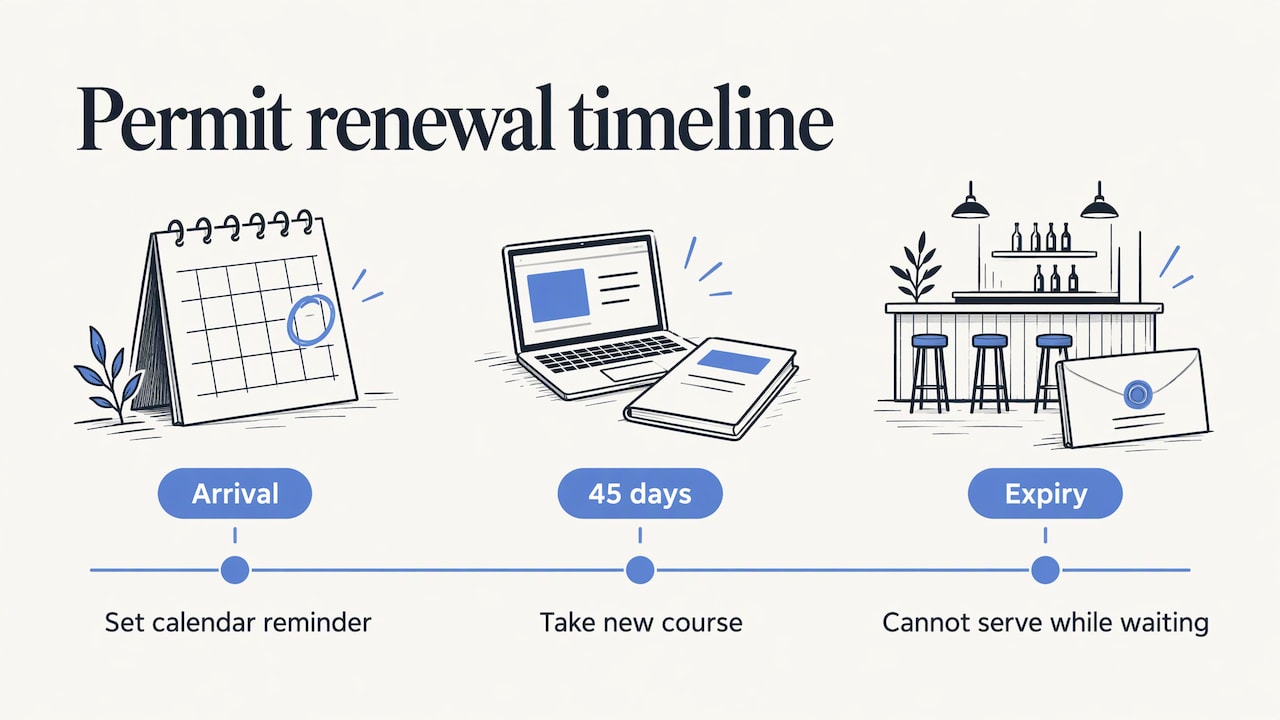
There is no grace period after expiration, and you cannot serve while you wait for the new permit. The LCB advises taking a new course 45 days before your current permit expires. Put a reminder in your calendar the day your permit arrives: a date about three months before expiry gives you room for the class, the exam and the mailing time.
Employers with many staff members benefit from a single list of expiration dates. Caterers who run staffing and compliance records through HACCP and traceability software can keep permit expiry dates alongside the rest of their event paperwork. A shared spreadsheet works for smaller venues.
Replacing a lost permit or changing a name
Your provider can replace a lost permit, process a name change, or upgrade a Class 13 to a Class 12. If you go through the state instead, the LCB’s replacement page says to mail the Application to Replace MAST Permit with a $5.00 check or money order made out to LCB to the LCB MAST Coordinator, PO Box 3724, Seattle, WA 98124-3724. The LCB says it processes replacements in about two business days after receiving the application.
What changed in 2025 and 2026
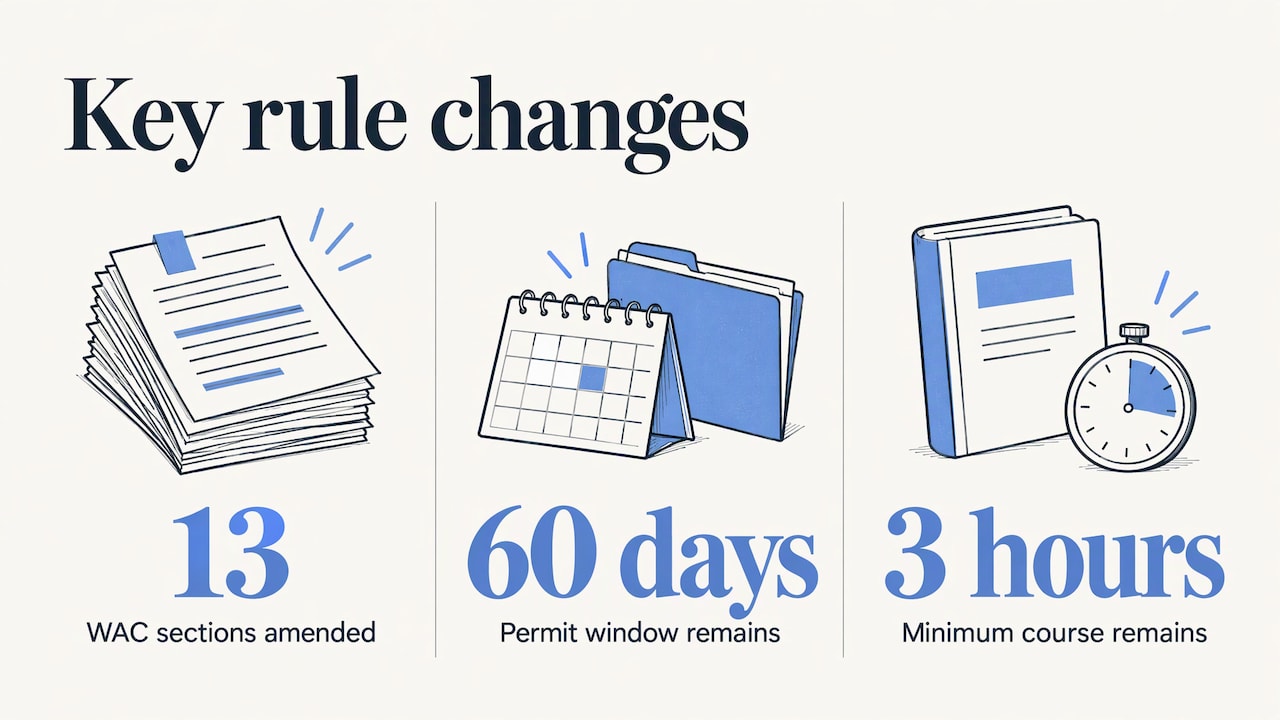
The LCB amended 13 WAC sections to align with House Bill 1698 (chapter 167, Laws of 2025). According to the LCB’s implementation memo, the changes introduced the defined term “on-premises licensed facility” and updated MAST requirements. They also eliminated the military installation permit and the public house license. The revised rules took effect January 20, 2026.
For most servers, nothing about the process changes: Class 12 and Class 13 remain, the 60-day window remains, and the course is still at least three hours. The practical effect is that older course materials and older descriptions of the rules may use outdated terms.
The rules also bar a provider from saying or implying that the state or any state agency endorses one provider’s program over another’s. That is why you should treat the LCB’s provider list as a list of certified options, and choose among them on format, ease and fit for your schedule.
Choosing a provider
Every provider on the LCB’s list is certified to issue Class 12 or Class 13 permits, so the permit itself carries the same legal weight. The differences are practical:
- Format. Online, classroom, or both.
- Device support. Whether you can finish on a phone between shifts.
- Pace. Whether you can stop and resume. The LCB confirms online students may.
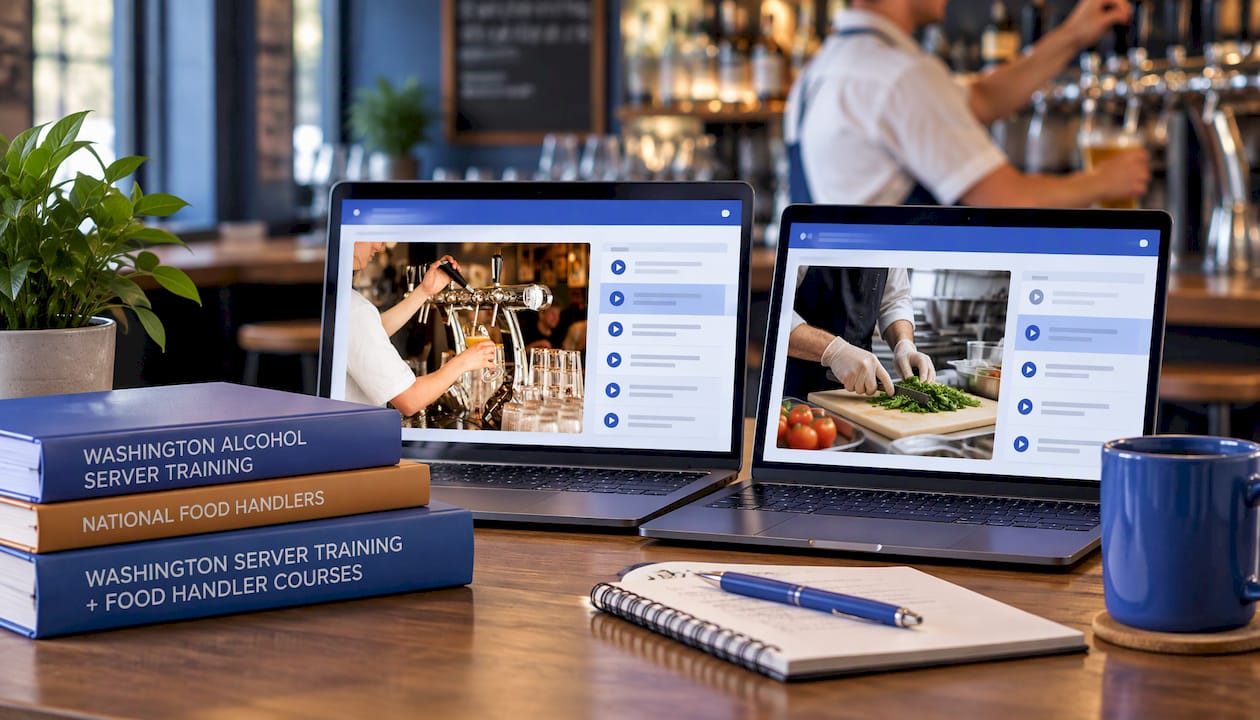
- Bundles. Whether you can add a food handler course at the same time, useful if you work in a restaurant.
- Team tools. Whether an employer can enroll and track a group.
Our course checks each of those boxes. If you also need a food handler card, the Washington server training and food handler bundle lets you take both from one account. For background on the rules, our guide to Washington’s alcohol server training requirements goes through them in more depth.
For employers: getting a whole team permitted
The employer carries real exposure when staff work without valid permits: the LCB says a business can face a fine, a license suspension, or both. A simple routine keeps you covered:
- Enroll every new hire in a class on their first day, not their fiftieth.
- Record each person’s class (12 or 13) and expiration date.
- Put the 45-days-before-expiry reminder for each person on a shared calendar.
- Make sure anyone supervising Class 13 holders has a Class 12.
- Keep Class 12 permits on file for tasting staff, who have no 60-day grace period.
We offer group and corporate training so managers can handle team compliance in one place rather than chasing individual receipts. Because our course is self-paced and works on any device, staff can complete it between shifts without a block of paid training time.
Get certified with ABC Server Training
Our Washington course is for bartenders, servers, managers and tasting staff who want to finish the state requirement without fuss. It is self-paced, works on any device, and is taught by a provider that has trained more than 100,000 learners. ABC Server Training appears on the LCB’s list of certified MAST providers. You can start with the Washington MAST training online, or take the Washington alcohol server training bundled with a national food handler course if you need both. Managers can set up team training from our home page.
Our perspective on Washington’s permit
Washington made the permit simple for workers: one state standard, a fixed 60-day window, and a class you can take online and finish in more than one sitting. The people who run into trouble are rarely the ones who struggle with the material. They are the ones who put it off, then discover there is no temporary permit and no grace period when a five-year permit lapses.
We built our training around that reality. A server who is working doubles should be able to open a course on a phone, finish a section on a break and come back later. A manager with a dozen new hires should be able to enroll them together and know who has finished. More than 100,000 learners have trained with us, and we design the course to help them pass the state exam the first time.
Our advice is the same for a new bartender and a restaurant owner: choose a certified provider, finish early, and calendar the expiration date the day the permit arrives.
the author
FAQ
How long does it take to get a Washington MAST permit?
The class is at least three hours long with an exam at the end, and online students can split it over several sessions. After you pass, the provider mails the permit and reports your completion to the LCB within 30 days. Finishing early in your 60-day window leaves room for the mailing.
Can I work while waiting for my permit?
Washington has no temporary permit, so the 60-day window from your hire date is the time you have. Once that window closes, you may not perform sale or service duties at an on-premises licensed facility without a valid permit. Enroll in your first week so the permit arrives well before the deadline.
Do I renew a MAST permit?
No. A MAST permit is good for five years and is not renewable, and there is no grace period after it expires. You take a new course, and the LCB advises doing so 45 days before your current permit expires.
Do I need a Class 12 or a Class 13 permit?
You need a Class 12 if you are 21 or older and mix, sell, manage or supervise Class 13 holders. You need a Class 13 if you are 18 or older and only take or deliver orders or pour beer or wine at the table. A Class 12 covers all Class 13 duties.
Can I take Washington alcohol server training online?
Yes. The LCB says MAST classes are offered online or in a classroom, and online students may log out and return where they left off. Choose a provider from the LCB’s certified list.
Sources
- Get an Alcohol Server Permit, Washington State Liquor and Cannabis Board
- FAQs for Mandatory Alcohol Server Training, Washington State Liquor and Cannabis Board
- Find a Class, Washington State Liquor and Cannabis Board
- Replace a MAST Permit, Washington State Liquor and Cannabis Board
- WAC 314-17-015, Washington Administrative Code
- RCW 66.20.310, Revised Code of Washington
- 2025 legislative implementation rule changes, WSR 26-03-072
- HACCP and traceability software for caterers