 My Account

 Login


The right online workplace safety course is the one that matches your job, your state and the rule your employer has to meet. For restaurant and bar staff, that usually means a state-specific course you finish on your phone or laptop, such as food handler, workplace violence prevention or sexual harassment training, with a certificate you can print for your manager. Our California Workplace Violence Prevention course costs $34.99, and our Food Handler’s Permit costs $13.99.
This guide is for servers, bartenders, managers and owners. It explains what these courses cover, what a certificate does and does not prove, how to match a course to your situation, and how to train a whole team without chasing paperwork.
TL;DR
- Pick the course by the rule it satisfies: your state, your industry and your job title decide which training you need, not the course name.
- A workplace safety certificate recognizes that you completed a course. The training provider sets what it takes to earn it.
- Restaurants and bars usually need a bundle: food handling, harassment prevention, workplace violence prevention and, for alcohol service, a state server course.
- Employers should keep completion records for every employee and plan refresher training for new hires and long-tenured staff alike.
- Self-paced online courses let each person finish on any device, which is why they work for shift-based teams.
Table of Contents
- What an online workplace safety course actually covers
- What a workplace safety certificate proves
- Which course fits which job
- Workplace violence prevention: a requirement that surprised many employers
- Food safety and hazard communication
- What about OSHA 10 and OSHA 30 cards?
- How to compare online courses before you buy
- Training a whole team without the paperwork
- Our perspective: why role-specific beats generic
- Get your course started
- FAQ
- Sources
What an online workplace safety course actually covers
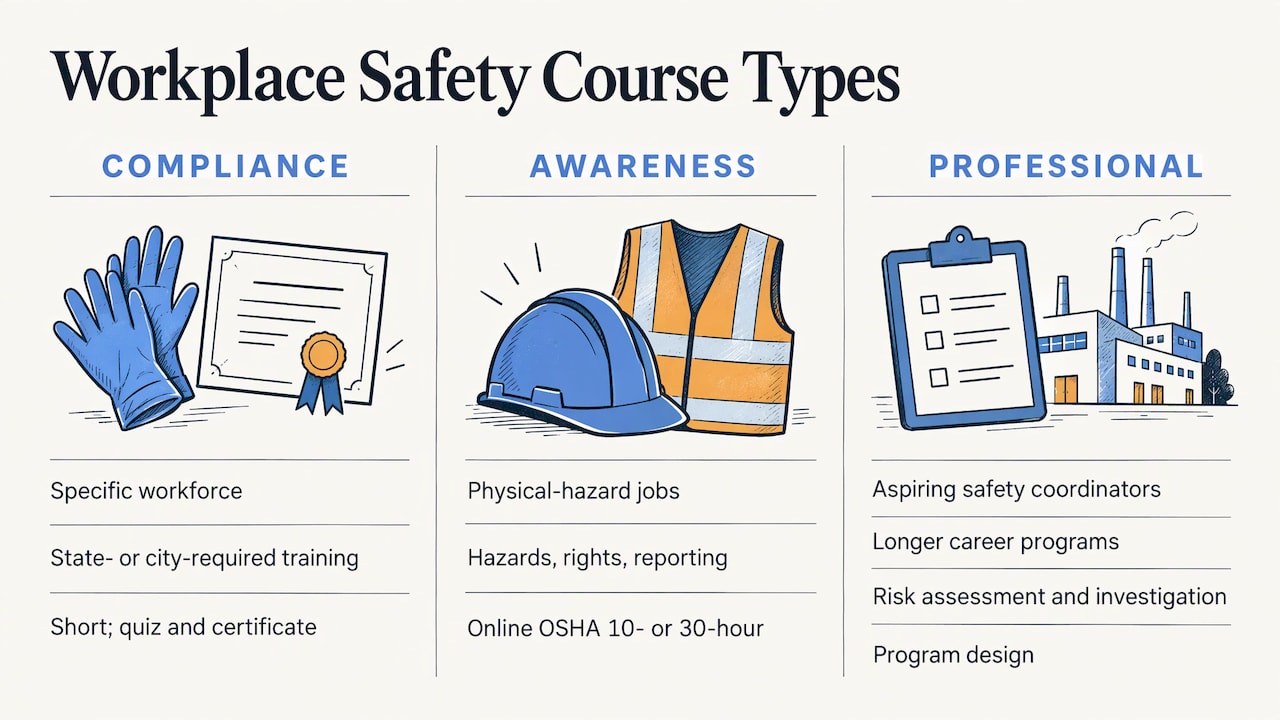
“Workplace safety” is a broad label. Courses under it range from a one-hour awareness class to a multi-day program for safety managers. Before you buy anything, sort the options into three groups.
Role- and state-specific compliance courses. These exist because a state or city law says certain employees must be trained. Food handler cards, responsible beverage server training, sexual harassment prevention and workplace violence prevention all fall here. They are short, written for a specific workforce, and usually end in a quiz and a certificate.
General industry or construction awareness programs. These teach hazard recognition, workers’ rights and how to report unsafe conditions. They suit people whose jobs involve physical hazards on a job site or in a plant. OSHA, the federal Occupational Safety and Health Administration, runs a voluntary Outreach Training Program for the 10-hour and 30-hour classes, and the classes can be taken online.
Professional safety education. These are longer programs for people building a career as a safety coordinator or manager. They cover risk assessment, incident investigation and program design.
If you wait tables, tend bar, run a kitchen or manage a restaurant, you almost certainly need the first group. It is the training your health department, state liquor authority or labor agency actually asks to see.
What restaurant safety training typically includes
The California Division of Occupational Safety and Health (DOSH) publishes a workplace safety guide for restaurant employees. It covers common violations, injury types, hazard controls, safety training, written injury and illness prevention programs, hazard communication programs and how to contact Cal/OSHA. It also recommends frequent refresher training for all employees, especially new and younger ones, built around the hazards in your own restaurant and your workplace’s safe work practices.
That is a useful picture of what a restaurant team should be trained on: the hazards of this kitchen and this floor, how to control them, and what to do when something goes wrong.
What a workplace safety certificate proves
Searchers often ask for “certification,” so it helps to know what the paper represents. OSHA states that it does not certify individuals. Certificates are generally awarded to recognize completion of a course or series of courses, and the provider determines the requirements.
In practice, that means a certificate is a record that you finished a defined course. It becomes valuable when the course is the one your employer, county or state asks for. A certificate from a course that does not match the rule you need to meet is just a nice file in your downloads folder.
Before you pay, ask three questions:
- Who requires it? A state law, a county health department, your employer’s insurer or your own career plan?
- Is the course written for my state? Training rules differ by state, and a course aimed at one state’s rules may not fit another’s.
- What do I receive at the end? A downloadable certificate, a permit or card, and a record your employer can keep.
Which course fits which job
| Your situation | Training that usually applies | Where we come in |
|---|---|---|
| Server or bartender in a state with a server training rule | State-specific responsible beverage server course | State alcohol server courses from $9.99 |
| Anyone who handles food | Food handler course and permit | Food Handler’s Permit, $13.99 |
| Kitchen or restaurant manager | Food manager certification with a proctored exam | Online and in-person proctored exam options |
| Employee in California | Workplace violence prevention, harassment prevention | California Workplace Violence Prevention, $34.99 |
| Owner or manager with a team | Group enrollment and record keeping | Group and corporate training |
The prices above are the published amounts on our site. Courses without a published price, such as sexual harassment training and food manager certification, are listed on our courses page.
Workplace violence prevention: a requirement that surprised many employers
Of all the workplace safety topics restaurants face, workplace violence prevention has changed most recently in California. Senate Bill 553 took effect on July 1, 2024, and covered employers must have a written workplace violence prevention plan, train employees and keep related records. According to a summary of the law, training is due when the plan is first put in place and at least once a year after that.

For a bar or restaurant, this is not abstract. Staff deal with intoxicated guests, cash handling, late closing shifts and the occasional customer who escalates. A plan on paper does little unless every server, host and bartender knows how to recognize warning signs and what the response procedure is.
A self-paced online course fits this well. A new hire can complete it before their first shift, and an owner can confirm completion for everyone without gathering the staff in a back room on a slow Tuesday afternoon. Our California Workplace Violence Prevention course is $34.99. If you want background on the requirements first, our guide to workplace violence prevention course requirements and options walks through them.
Harassment prevention for California teams
Harassment training is the other California rule that catches small employers off guard. The California Restaurant Association describes a 2-hour Sexual Harassment Prevention Training as required for businesses with five or more employees. If you are not sure whether the rule reaches your staff, our explainer on whether harassment training is required for employees in California lays it out. Our sexual harassment training is listed on the courses page.
Food safety and hazard communication
Food handler training is the most common safety credential in hospitality. Requirements vary by state and sometimes by county, so a course built for your location matters more than the brand on it. Our Food Handler’s Permit is $13.99, and our food handler’s training overview explains what the training covers. Managers who need the higher credential can look at our Food Manager’s Certification with an online or an in-person proctored exam, both listed on the courses page. A proctored exam is one supervised by an approved proctor, either remotely or in person. For a wider look at what a team needs, see restaurant food safety training.
A deadline for hazard communication
Kitchens and bars use cleaners, sanitizers and other chemicals, and that puts them under OSHA’s Hazard Communication Standard (HCS), the rule that governs chemical labels and employee training. The revised HCS sets a deadline: employers must update workplace labeling, their hazard communication program and employee training for newly identified hazards by November 20, 2026 for substances and May 19, 2028 for mixtures.
If your operation includes packaged food or beverage service, such as vending or micro-markets, labeling goes beyond chemicals. This resource on allergen-safe vending routes shows how labeling practices fit into a safe operation. Washington’s Department of Labor & Industries also offers restaurant industry training resources, including hazard communication and bloodborne pathogen kits.
What about OSHA 10 and OSHA 30 cards?
Many people searching for an online workplace safety course are really asking about the OSHA 10-hour or 30-hour card. The Outreach Training Program is voluntary under federal law, but OSHA notes that some states and local jurisdictions mandate it, and some employers and unions require it, as described in OSHA’s program requirements.
The card is mostly a construction and general industry matter. If a job site or union asks for one, you will know, because the requirement comes in writing from the employer or contractor. Restaurant and bar staff are more often asked for food handler cards, server permits, and harassment and violence prevention certificates. Start from the list your employer or state gives you, and match the course to it.
How to compare online courses before you buy
Good courses share a handful of traits. Use this checklist.
- Written for your state or industry. Generic content leaves you guessing about local rules.
- Self-paced. Shift workers need to stop, restart and finish on a break or at home.
- Works on any device. If your team lives on phones, a course that needs a desktop will not get finished.
- Clear price. The full cost should show before checkout.
- A certificate you can download and share. Your manager needs a record.
- Team tools. If you employ more than a few people, you want one place to enroll and track staff.
Those are the traits we built our platform around: user-friendly courses, flexible self-paced completion, and access from any device.
Training a whole team without the paperwork
Owners and managers carry a different problem from individual learners. It is not only whether training exists. It is whether every person has finished it, whether you can show proof, and whether new hires start on time.
A practical routine looks like this:
- List every role and the training each one needs. Servers, bartenders, cooks, hosts, dishwashers and managers often differ.
- Assign the courses at hire. Make training part of onboarding, before the first scheduled shift where the rule allows.
- Collect completion certificates in one place. Whether it is a shared folder or a platform dashboard, keep every record together.
- Set a refresher rhythm. DOSH recommends frequent refresher training, especially for new and younger employees, and the California workplace violence rule requires annual training for covered employers.
- Review before inspections or insurance renewals. The best time to find a gap is not when an inspector finds it.
Our group and corporate training option is built for step 2 and step 3: you enroll your team and manage training for everyone from one account. Details are on our home page. To see the other mandatory trainings a restaurant or grocery team may face, read our guide to mandatory training for employees.
Our perspective: why role-specific beats generic
We have trained more than 100,000 learners, and one pattern repeats: people do best when the course matches the job they actually do. A server does not need a lecture designed for a steel plant. A server needs to understand the rules that govern their shift, in plain language, and to finish before the next schedule posts.
That is why we build state-specific courses and keep them self-paced and device-friendly. Hospitality is a business of split shifts, second jobs and short breaks. Training that bends around that schedule gets completed. Training that demands a classroom day often does not.
For owners, the same logic applies to compliance. Training is easiest to manage when your staff, your records and your renewals sit in one place. Our group and corporate options exist for that reason, and our pass rate is the highest in the industry.
If you are choosing a course today, start with the rule you need to satisfy, pick the course written for it, and complete it while the topic is fresh. The right training protects your staff first and your business second.
the author
Get your course started
If you work in food and beverage service, one account can cover most of what you need. We offer state-specific alcohol server training from $9.99, a Food Handler’s Permit for $13.99, California Workplace Violence Prevention for $34.99, and sexual harassment and food manager options on our courses page. You can browse the full list of state courses and prices in our shop.

Employers who want to enroll several people can start from our group and corporate training option and manage the team in one place. State courses in places like Arkansas, Kentucky and Missouri also come with food handler options.
FAQ
Is an online workplace safety course enough for my job?
It is enough when it is the course your employer, state or county asks for. Check the written requirement for your role, then choose the course written for it. For restaurant staff, that is usually food handler, alcohol server, harassment prevention or workplace violence prevention training.
Does a workplace safety certificate expire?
It depends on the rule behind it. California’s workplace violence rule, for example, calls for training at least once a year for covered employers, according to a summary of SB 553. Food handler and server permits have their own renewal periods set by the state or county, so check the one that applies to you.
How long does an online safety course take?
It varies by topic. Food handler courses are short, and some harassment prevention courses run around two hours, as the California Restaurant Association describes for its own program. Our courses are self-paced, so you can stop and resume on any device.
Can my employer pay for my training or enroll the whole team?
Yes. Employers can buy training for staff, and our group and corporate option lets a manager enroll a team and track completion. Ask your manager whether the business covers the cost for your role.
Do I need an OSHA 10 card to work in a restaurant?
Usually not. The OSHA 10-hour and 30-hour programs are voluntary under federal law, and OSHA says only some states, local jurisdictions, employers and unions require them. Restaurant staff more often need food handler, alcohol server, harassment or workplace violence training.
Sources
- OSHA: Can I become certified through the Outreach Training Program?
- OSHA: Can I get the OSHA 10-hour card online?
- OSHA: Outreach Training Program requirements 2024
- California DIR-DOSH: Restaurant Employees Workplace Safety and Health Guide
- Washington L&I: Restaurant, Food and Beverage Industries
- National Law Review: Revised HCS deadline for employers
- Envoy: California Senate Bill 553 summary
- California Restaurant Association: Compliance and safety trainings
- Jeeves: Allergen-safe vending routes