 My Account

 Login


If you work with food in Illinois, you need food handler training within 30 days of starting the job, and the certificate you earn is good for three years. The state does not issue the certificate itself. You take an approved course, pass the assessment and print your certificate, usually in under an hour and from any device. Below you will find who has to do it, who is exempt, what counts as an approved course, what it costs and what employers must keep on file.
TL;DR
- Most Illinois food handlers must complete training in basic food handling within 30 days after being hired, unless they hold a Certified Food Protection Manager (CFPM) certification.
- For restaurant workers, the course must be ANSI accredited or approved by the Illinois Department of Public Health (IDPH).
- The certificate is valid for three years, then you retrain.
- State law requires at least one approved option at $15 or less per employee.
- Employers must be able to show proof of training to a health inspector on request, and electronic records are fine.
Table of Contents
- Do you need an Illinois food handler certificate?
- The 30-day rule and three-year renewal
- What counts as an approved course
- How to get your certificate online
- What it costs
- For employers: records and compliance
- Our perspective
- Get started with ABC Server Training
- Common mistakes to avoid
- FAQ
- Sources
Do you need an Illinois food handler certificate?
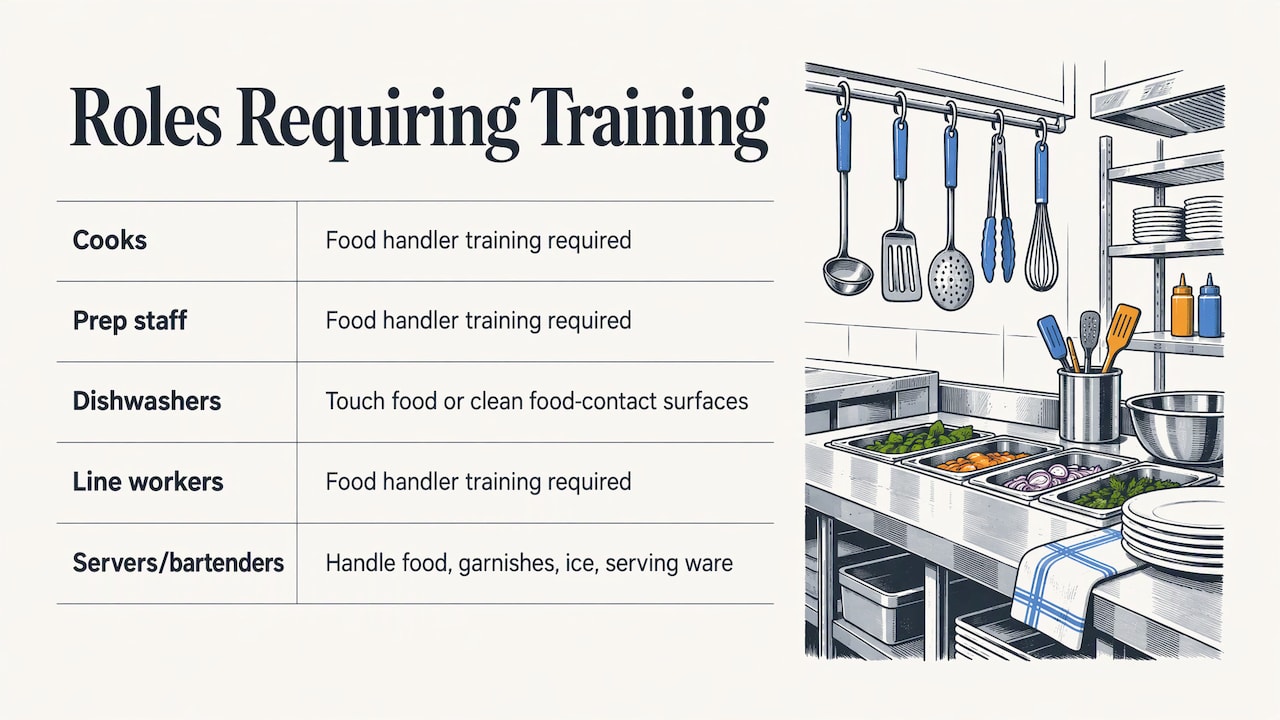
Yes, if you handle food in Illinois and you are paid for it. According to the IDPH Food Handler FAQ, any food handler working in the state must have food handler training, with a few exceptions. That includes cooks, prep staff, dishwashers who touch food or clean food-contact surfaces, line workers, and servers and bartenders who handle food, garnishes, ice or serving ware.
A small point of wording: people search for the “certificate,” the “card” and the “certification,” and they all mean the same thing in Illinois. It is proof that you completed an approved food handler course and passed its assessment. The state does not issue food handler certifications, so there is no government application form. The proof comes from the course provider.
Who is exempt
Per the same IDPH FAQ, the following people do not need food handler training:
- Workers who hold a valid Certified Food Protection Manager (CFPM) certification.
- Unpaid volunteers.
- Employees of temporary food establishments.
- Nursing and therapy staff in care settings. Training is encouraged for them but not required.
If you are a manager with a CFPM, you are covered. Many managers still choose to put their line staff through the shorter food handler course, because their staff are the ones who need it. If your team includes people in more than one of these groups, treat each person individually rather than assuming the whole location is exempt.
The 30-day rule and three-year renewal
The timeline is simple, and employers and employees both need to know it.
- Within 30 days of hire: Illinois administrative code requires food handlers, other than those with CFPM certification, to obtain training in basic food handling principles within 30 days after employment begins.
- Every three years: IDPH states that ANSI food handler training certificates are good for three years. Restaurant employees must be retrained on that cycle.
- Changing jobs: IDPH says restaurant food handler training certificates are valid throughout the state, with one exception: training obtained internally at a single facility may not travel with you. A certificate from an accredited online provider is the portable kind.
A practical tip: put your expiration date in your phone calendar the day you print the certificate. The three years go faster than most people expect, and a lapsed certificate means a short course is due again.
What counts as an approved course
This is the part that trips people up. Not every food safety course online is accepted in Illinois. IDPH requires food handler training programs to be ANSI accredited, or to be internal training programs approved by IDPH. IDPH also keeps a listing of ANSI-accredited programs.
Here is how that breaks down in practice:
| Type of training | Who it fits | What to know |
|---|---|---|
| ANSI-accredited online course | Individual workers and employers with several locations or high turnover | Self-paced, available around the clock, certificate prints right after you pass |
| IDPH-approved internal program | A single employer training its own staff | May not be accepted at another facility |
| CFPM (food protection manager) certification | Managers and persons in charge | Replaces the food handler requirement for the certified person |
| Classroom or live trainer | Teams that prefer in-person sessions | Allowed by law, as long as the program meets the accreditation standard |
The law is flexible on format. Illinois law says training modules may be delivered online, by computer, in a classroom, by live trainers or by remote trainers. So an online course is a fully valid route, not a workaround.
Before you pay for any course, open IDPH’s list and check that the program is on it. It takes a minute, and it is the one step that protects you from paying for a certificate your employer or inspector will not accept.
How to get your certificate online
For restaurant workers, IDPH explains that ANSI-approved food handler courses can be completed online 24 hours a day without instructor monitoring, and that the certificate is immediately available to print once you pass the assessment.
The steps look like this:
- Pick an approved course from the IDPH list of ANSI-accredited programs.
- Register and pay. There is no state fee, so you pay the provider only.
- Work through the modules at your own speed. Most people use a phone or laptop, stop between lunch rushes and pick up where they left off.
- Pass the assessment. The course covers basic food handling principles: personal hygiene, preventing cross-contamination, time and temperature control, cleaning and sanitizing, and allergen awareness.
- Print or save your certificate and give a copy to your manager. Keep your own copy as well.
If you are also serving alcohol, remember that food handler training and alcohol server training are separate things. In Illinois, servers and bartenders typically need BASSET training for alcohol and food handler training for food. Our guide to Illinois BASSET certification for restaurant staff explains the alcohol side.
What it costs
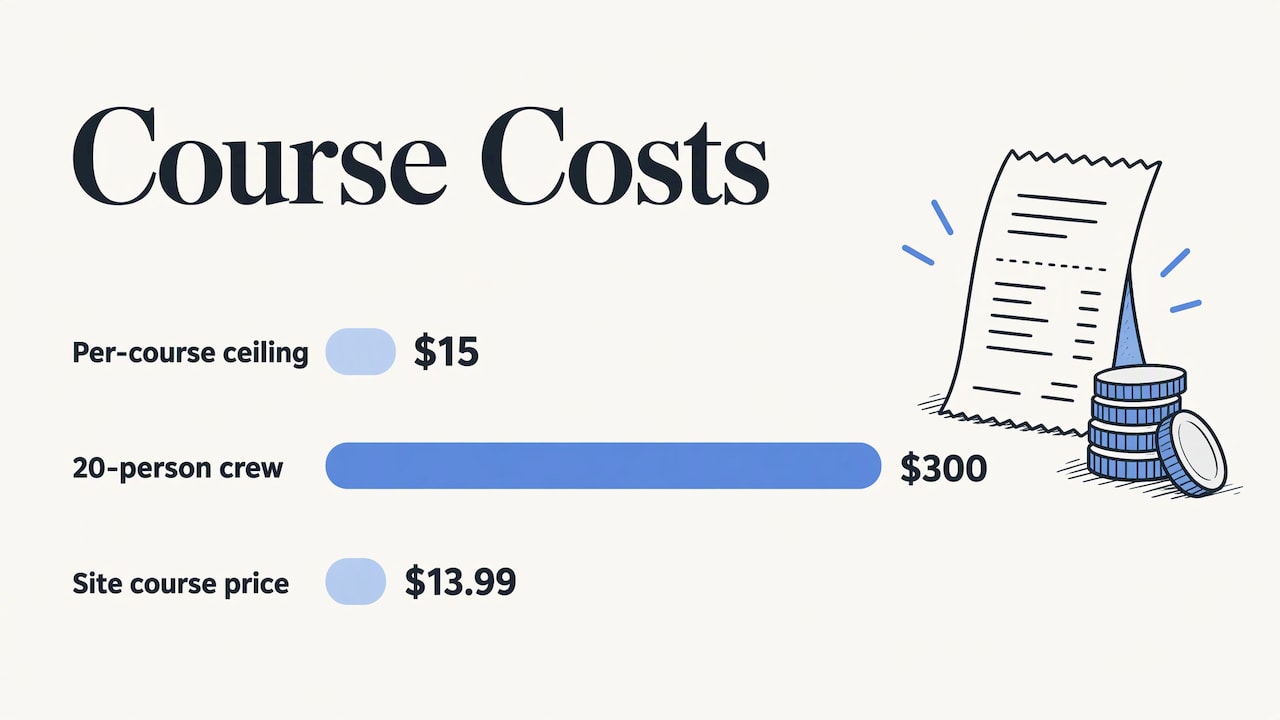
The state does not set one fee. IDPH states there is no set fee for the course, but Illinois law requires at least one commercially available approved food handler training module at no more than $15 per employee. IDPH adds that multiple ANSI-approved programs are available online at that price.
What that means for you:
- Individuals: you should not need to spend more than about $15 for an approved course. If a price is far above that, look at what else is included, such as a bundle with another certification.
- Employers: the cost of training one cook is small. Training a whole crew of 20 at the $15 ceiling comes to $300 at most, which is far less than the disruption of a failed inspection.
- Who pays: Illinois law does not say in the sources we reviewed that the worker must pay. Ask your employer whether they reimburse the course. Many restaurants do, since they need proof on file anyway.
On our site, the Food Handler’s Permit course is priced at $13.99. For Illinois-specific bundles of server training and food handler courses, see our Illinois Server Training + Food Handler Courses page for current pricing.
For employers: records and compliance
If you run a restaurant or bar in Illinois, the paperwork is as important as the training. The administrative code requires that proof a food handler has been trained be available on reasonable request by a State or local health department inspector, and that proof may be electronic.
A simple system that works:
- Keep a roster with each employee’s hire date, course completion date and expiration date.
- Store a PDF of each certificate in a shared folder, so it is available when an inspector asks.
- Set a reminder at 30 days after each hire, and another about 60 days before each three-year expiration.
- Record CFPM-certified staff separately, along with their certificate expiration dates.
- Include seasonal and part-time employees. The exemption for temporary food establishments does not cover your regular business.
The 30-day window is the one that causes violations. A cook hired in the first week of the month and never enrolled is out of compliance by the next month. Many managers make the course part of the first-week paperwork, alongside the tax forms.
Our perspective
We train servers, bartenders, cooks and managers every day, and the pattern is the same: people put off the certificate until the deadline is close, then want it done in one sitting. That is why we built our courses to be self-paced and to work on any device, so a new hire can finish between shifts on a phone.
Our view is that a food handler certificate should be the easy part of starting a job. The training should be short and clear, and the certificate should be in your hands when you finish. It should also sit alongside the other credentials you may need. Many of our learners need alcohol server training too, which is why we offer both from one place, with state-specific courses and food handler courses side by side.
For employers, we think the real value is in managing a team. Group and corporate options let a manager enroll staff, keep completion records in one place and stay ahead of the 30-day and three-year deadlines. With more than 100,000 learners trained, we have seen how much smoother compliance gets when training is built into onboarding.
the author
Get started with ABC Server Training
If you want to handle food and alcohol certification in one place, our Illinois Server Training + Food Handler Courses page is the place to begin. You work at your own pace on any device, and our courses are designed for people who need to finish quickly and get back to work.

Managing a whole crew? Our group and corporate training options help you enroll your team and track compliance. You can also read more about food handler training requirements across states if you operate in more than one state.
Common mistakes to avoid
- Taking a course that is not on the IDPH list. A certificate from a non-accredited program may be rejected.
- Assuming a manager’s CFPM covers the staff. The exemption belongs to the person who holds the certification.
- Missing the 30-day window. Enroll new hires in their first week.
- Forgetting renewal. Three years from the completion date, you retrain.
- Relying on internal training that does not travel. If you may change employers, get an accredited certificate that is valid statewide.
- Losing the certificate. Save a digital copy and send one to your employer.
FAQ
Is an Illinois food handler certificate the same as a food handler card?
Yes. Card, certificate and certification are used interchangeably for the proof you receive after passing an approved course. The state does not issue it, so it comes from your training provider, and you can print it as soon as you pass.
How long is the certificate valid?
It is good for three years. IDPH says ANSI food handler training certificates last three years, and restaurant employees must be retrained on that schedule. Write your expiration date down when you finish.
Can I take the course entirely online?
Yes. IDPH says ANSI-approved courses for restaurant workers can be completed online 24 hours a day without an instructor monitoring you. Once you pass the assessment, you can print the certificate right away.
Do servers and bartenders need a food handler certificate?
If you handle food, ice, garnishes or serving ware as part of your paid job, you generally fall under the food handler requirement unless you hold a CFPM certification. Alcohol server training is a separate requirement, so many servers and bartenders complete both.
What happens if I do not complete training within 30 days?
The rule requires training within 30 days after you start work, and proof must be available to inspectors. Finish the course as soon as possible and give your manager the certificate. Your local health department can answer questions about specific enforcement.
Sources
- IDPH Food Handler FAQ
- IDPH Food Handler Training
- Illinois Administrative Code, Part 750, Section 2300 (food handler training)
- 410 ILCS 625/3.05, Illinois Food Handling Regulation Enforcement Act